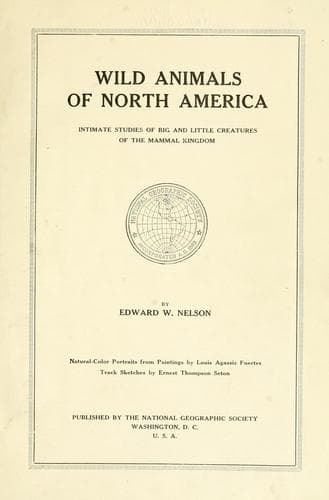
Wild Animals of North America: Intimate Studies of Big and Little Creatures of the Mammal KingdomNelson, Edward William
Science
Wild Animals of North America: Intimate Studies of Big and Little Creatures of the Mammal Kingdom
Nelson, Edward William
Mammals -- North America
Although essentially a tree animal, much of the fisher’s time is spent
on the ground. In summer it appears to be fond of heavy forests in
low-lying situations and the vicinity of water. Its dens are usually
located in a hollow high up in a large tree, but sometimes in the
shelter of fallen tree trunks or crevices in the rocks, where, the last
of April or early in May, the young are born. These may number from
one to five, but are usually two or three. The young begin to follow
the mother in her wanderings when quite small and do not leave her
guardianship until nearly grown.
The fisher is not a common animal and only about 8,000 of its skins are
marketed each year. Owing to its size, it is conspicuous, and its very
fearlessness tends to jeopardize its existence. It is gone from most
of the southern part of its former range and will no doubt continue
steadily to lose ground with the increasing occupation of its haunts.
=OTTER= (=Lutra canadensis= and its relatives)
Land otters are common throughout a large part of the Old World,
and when America was explored the animals were found generally
distributed, and sometimes common, from the northern limit of trees
in North America to southern South America. Within this great area a
considerable number of species and geographic races of otters occur,
all having a close general resemblance in appearance and habits.
The Canadian otter is the well-known type throughout the United States,
Canada, and Alaska. It is a slender, dusky brown animal, from 4 to 5
feet in length, frequenting streams and lakes which contain a good
supply of fish. Otters are too short-legged to move easily on land, but
are remarkable for their admirable grace, agility, and swiftness in the
water. Although so poorly adapted to land travel, they are restless
animals, constantly moving up and down the streams in which they live
and often crossing from one stream to another. In the far north in
midwinter they travel surprising distances across snow-clad country,
following the banks of streams or passing between them searching for an
entrance to water, whether through the ice or in open rapids.
In Alaska I saw many otter trails in the snow crossing the Yukon and
through the adjacent forest. In such journeys it was evident that
the animals progressed by a series of long bounds, each leaving a
well-marked, full-length impression in the snow, so characteristic
that it could not be mistaken. These trails, often leading for miles
across country, always excited my deepest interest and wonder as to how
these animals could succeed in finding holes through the ice in this
vast snow-bound waste. Nevertheless they seemed to know full well, for
the trails always appeared to be leading straight away for some known
objective.
Public-domain text, read in full here on John Shaqi.
Reviews
Reviews
No reviews yet
Be the first to share your thoughts on this work.
Elsewhere in the archive
Join the Discussion
Join the discussion
Sign in to leave a comment or review.
Sign InorCreate an account