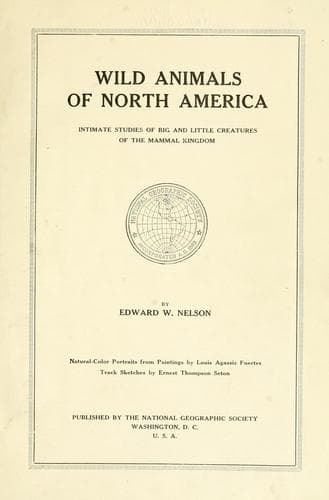
Wild Animals of North America: Intimate Studies of Big and Little Creatures of the Mammal KingdomNelson, Edward William
Science
Wild Animals of North America: Intimate Studies of Big and Little Creatures of the Mammal Kingdom
Nelson, Edward William
Mammals -- North America
In the New World they occur only in North America, where there are
two or three species, with numerous geographic races. Among these the
sheep inhabiting the main Rocky Mountain region is best known. It is
a heavier animal than its northern relatives of the Stikine country
and Alaska, with larger and more massively proportioned horns. It
occupies the main range from south of Peace River and Lake Babine,
in British Columbia, to Colorado, and possibly northern New Mexico.
Closely related geographic races occur elsewhere in the mountains of
the western United States and northern Mexico.
The usual conception of wild sheep as habitants of the cold, clear
upper world at timberline and above is justified in the case of
the Rocky Mountain sheep. In early spring its one or two young are
born amid these rugged elevations, where it remains until the heavy
winter snows drive it down, sometimes through the open timber to the
foothills. That wild sheep thrive equally well under very different
conditions, however, is shown by their abundance on the treeless
mountains of our southwestern deserts, among cactuses, yuccas, and
other thorny vegetation, where water is extremely scarce and summer
temperatures rise high above 100° Fahrenheit in the shade.
The Rocky Mountain sheep, like other species, appears to feed on nearly
every plant growing within its domain. In spring many lambs are killed
by bald and golden eagles, and in winter, when driven down to lower
levels by snow, it becomes easy prey for mountain lions, wolves, and
coyotes. Owing to continuous hunting, this sheep has disappeared from
many of its former haunts and is decreasing in most of its range. When
effective protection is undertaken in time, however, as in Colorado,
the range is readily restocked.
The sure-footedness with which a band of these sheep will dash in
full flight up or down seemingly impossible slopes, where a misstep
would mean death, is amazing. Even the old rams, with massive sets of
horns, bound from point to point up a steep rock slope with marvelous
grace and agility. Mountain sheep living among the rugged summits of
high ranges possess the courage and prowess of skillful mountaineers,
so admired by all, and the mere sight of one of these animals in its
native haunts is an adventure achieved by few.
No other big-game animal carries with it the romantic glamour which
surrounds this habitant of the cold, clear upper world. Big-game
hunters prize above all others their mountain-sheep trophies, which
form vivid reminders of glorious days amid the most inspiring
surroundings and evidence their supreme prowess in the chase.
STONE MOUNTAIN SHEEP (Ovis stonei)
Owing to its dark, iron gray color, _Ovis stonei_ is often called the
“black” mountain sheep. Despite its dark color, the Stone sheep is
probably a geographic race of the pure white Dall sheep of Alaska. It
has the same slender, gracefully coiled horns, frequently amber colored
and extended in a widely spread spiral.
Public-domain text, read in full here on John Shaqi.
Reviews
Reviews
No reviews yet
Be the first to share your thoughts on this work.
Elsewhere in the archive
Join the Discussion
Join the discussion
Sign in to leave a comment or review.
Sign InorCreate an account