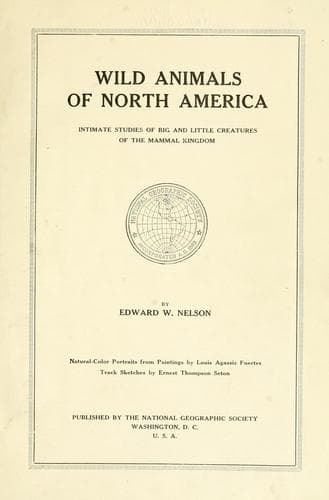
Wild Animals of North America: Intimate Studies of Big and Little Creatures of the Mammal KingdomNelson, Edward William
Science
Wild Animals of North America: Intimate Studies of Big and Little Creatures of the Mammal Kingdom
Nelson, Edward William
Mammals -- North America
Its range lies in northern British Columbia, especially about the
upper Stikine River and its tributaries; thence it extends easterly to
Laurier Pass in the Rocky Mountains, north of Peace River, and south
perhaps to Babine Lake. Unfortunately it appears to have become extinct
in the southern border of its range, so that its real relationship with
the Rocky Mountain sheep farther south may never be determined.
The sheep occupying the mountains between the home of typical _stonei_
and that of _dalli_ in northwestern British Columbia and southeastern
Yukon Territory are characterized by having white heads, with bodies of
a varying shade of iron gray, thus showing evident intergradation on a
great scale between the white northern sheep and the “black” sheep of
the Stikine. These intermediate animals have been called the Fannin, or
saddle-backed, sheep (_Ovis fannini_). Hunters report a considerable
mingling of entirely white animals among flocks of these intergrading
animals, and occasionally white individuals are seen even in flocks of
the typical dark sheep of the Stikine country.
Like the white Alaskan sheep, the Stone sheep exists in great
abundance in many parts of its range, especially east of Dease Lake.
It usually ranges in flocks, those made up of ewes and young rams
often containing a considerable number. The old bucks, except in fall,
keep by themselves in smaller bands in separate parts of the range.
The Stone sheep lives in one of the most notable big-game fields of
the continent. Its home above timberline is shared with the mountain
goat and in the lower open slopes with the caribou, while within the
adjacent forests wander the moose and two or more species of bear.
Owing to its frequenting remote and sparsely inhabited country, it
continues to exist in large numbers; but if its range becomes more
accessible, only the most stringent protection can save this splendid
animal from the extermination already accomplished on the southern
border of its range.
DALL MOUNTAIN SHEEP (Ovis dalli)
The only variation in the pure white coat of the Dall sheep is a
mixture of a few black hairs on the rump, sometimes becoming plentiful
enough to form a blackish spot on the tail and a light brownish stain
over the entire body, due to the slight discoloration at the tips of
the hairs from contact with the earth in their bedding-down places.
Their horns are usually dull amber yellow and are notable for their
slender proportions and the grace of their sweeping coils, which
sometimes curve close to the head and again spread in a wide, open
spiral.
Public-domain text, read in full here on John Shaqi.
Reviews
Reviews
No reviews yet
Be the first to share your thoughts on this work.
Elsewhere in the archive
Join the Discussion
Join the discussion
Sign in to leave a comment or review.
Sign InorCreate an account