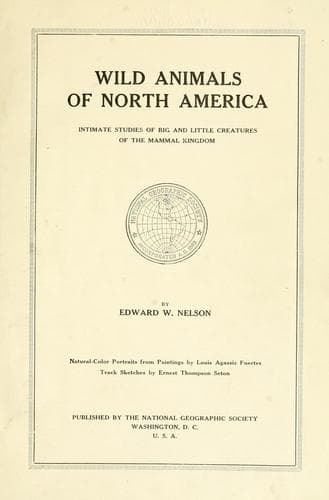
Wild Animals of North America: Intimate Studies of Big and Little Creatures of the Mammal KingdomNelson, Edward William
Science
Wild Animals of North America: Intimate Studies of Big and Little Creatures of the Mammal Kingdom
Nelson, Edward William
Mammals -- North America
The rump patch of the prong-horn is formed of long pure white hairs,
which in moments of excitement or alarm are raised on end to form two
great chrysanthemum-like white rosettes that produce an astonishingly
conspicuous directive color mark. The power to raise these hairs is
exercised by the fawns when only a few days old. Even when the hairs
are not erected the rump patch is conspicuous as a flashing white
signal to a distance of from one to two miles as the antelope gallops
away. When the animal whose rump signal has been plainly visible at a
distance suddenly halts and faces about to look back, as is a common
custom, its general color blends with that of the background and it
vanishes from sight as by magic.
Early explorers discovered antelope in great abundance over a vast
territory extending from near the present location of Edmonton,
Alberta, south to near the Valley of Mexico, and from central Iowa west
to the Pacific coast in California. They were specially numerous on the
limitless plains of the “Great American Desert,” where our pioneers
found them in great bands, containing thousands, among the vast herds
of buffalo. So abundant were they that it has been estimated that on
the Great Plains they equaled the buffalo in numbers. Now reduced to
a pitiful remnant of their former numbers, they exist only in widely
scattered areas, where they are constantly decreasing. Fortunately they
are strictly protected by law in most of their remaining territory.
The great herds containing thousands of antelope were usually formed
late in fall and remained together throughout the winter, separating
into numerous smaller parties during the summer. For years following
the completion of the transcontinental railroads they were commonly
seen from the car windows as trains crossed the Great Plains. At such
times their bright colors and graceful evolutions, as they swept here
and there in erratic flight or wheeled in curiosity to gaze at the
passing train, never failed to excite the deepest interest.
In early days prong-horns were noted for their curiosity and were
frequently lured within gun-shot by waving a red flag or by other
devices. I have repeatedly seen them circle or race a team, or a
horseman, crossing their range. In racing a horseman traveling along
an open road or trail they gradually draw nearer until finally every
member of the band dashes madly by only a few yards in front and then
straight away across the plains in full flight.
The prong-horns appear to possess a highly nervous temperament, which
requires for their welfare the wide free sweep of the open plains. They
do not thrive and increase in inclosures, even in large game preserves,
as do deer, elk, and buffalo. For this reason, it will require the
greatest care to protect and foster these attractive members of our
fauna to save them from soon being numbered among the many wild species
which have been destroyed by the coming of civilized man.
Public-domain text, read in full here on John Shaqi.
Reviews
Reviews
No reviews yet
Be the first to share your thoughts on this work.
Elsewhere in the archive
Join the Discussion
Join the discussion
Sign in to leave a comment or review.
Sign InorCreate an account