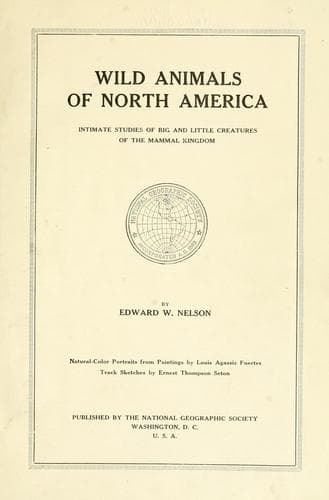
Wild Animals of North America: Intimate Studies of Big and Little Creatures of the Mammal KingdomNelson, Edward William
Science
Wild Animals of North America: Intimate Studies of Big and Little Creatures of the Mammal Kingdom
Nelson, Edward William
Mammals -- North America
The range of these habitants of the cliffs extends from the head of
Cook Inlet, Alaska, easterly and southerly through the mountains to
Montana and Washington. Unlike mountain sheep, the goats do not appear
to dislike the fogs and saline winds from the sea, and at various
points along the coast of British Columbia and Alaska they range down
precipitous slopes nearly to the shore.
They are much more closely confined to rugged slopes and rocky ledges
than the mountain sheep, which in winter commonly descend through the
foothills to the border of the plains. Through summer and winter, goats
find sufficient food in the scanty vegetation growing among the rocks,
and their heavy coats of hair protect them from the fiercest winter
storms.
Owing to their small horns and unpalatable flesh they are less sought
after by hunters than mountain sheep, and thus continue to exist in
many accessible places where otherwise they would long since have
become exterminated. They are frequently visible on the high ledges
of a mountain across the bay from the city of Vancouver and are not
difficult to find in many other coastal localities.
Although marvelously surefooted and fearless in traversing the faces of
high precipitous slopes, goats lack the springy grace and vivacity of
mountain sheep and move with comparative deliberation. They are reputed
to show at times a stupid obstinacy when encountered on a narrow ledge,
even to the point of disputing the right of way with the hunter.
Their presence lends interest to many otherwise grim and forbidding
ranges where, amid a wilderness of glacier-carved escarpments, they
endure the winter gales which for days at a time roar about their
cliffs and send snow banners streaming from the jagged summits overhead.
Owing to the character of their haunts, mountain goats have few natural
enemies. The golden and bald eagles now and then take toll among
their kids, but the lynx and mountain lion, their four-footed foes,
are not known to prey upon them to any considerable extent. Through
overhunting they have vanished from some of their former haunts, but
still hold their own in many places, and with effective protection will
long continue to occupy their peculiar place in our fauna.
=PRONG-HORN ANTELOPE= (=Antilocapra americana= and its
geographic races)
Unique among the antelope of the world, among which it has no near
relatives, the prong-horn, because of its beauty of coloration, its
grace, and fleetness, claims the attention of sportsmen and nature
lovers alike. It is a smaller and slenderer animal than the larger
forms of the Virginia deer. Its hair is coarse and brittle, and the
spongy skin lacks the tough fiber needed to make good buckskin. Both
sexes have horns, those of the doe being smaller and slenderer. One
of the extraordinary peculiarities of this antelope is its habit of
shedding the horns every fall and the developing new horns over the
remaining bony core.
Public-domain text, read in full here on John Shaqi.
Reviews
Reviews
No reviews yet
Be the first to share your thoughts on this work.
Elsewhere in the archive
Join the Discussion
Join the discussion
Sign in to leave a comment or review.
Sign InorCreate an account