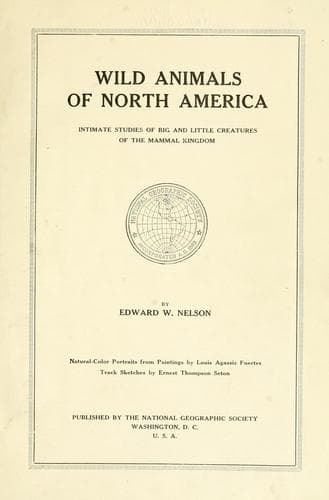
Wild Animals of North America: Intimate Studies of Big and Little Creatures of the Mammal KingdomNelson, Edward William
Science
Wild Animals of North America: Intimate Studies of Big and Little Creatures of the Mammal Kingdom
Nelson, Edward William
Mammals -- North America
During the last few years great interest has been shown in the
reintroduction of elk in parts of their former range, where they had
been exterminated and where conditions are still suitable for their
perpetuation. Such efforts are meeting with much success. Not only
do the animals thrive and increase rapidly, but local sentiment is
almost unanimous in their favor. This is well shown by the active
interest taken by both cattle and sheep owners in northern Arizona in
regard to a band of elk introduced a few years ago on their mountain
stock ranges. The stockmen exercise a virtual wardenship over these
animals that insures them against molestation, and the herd is rapidly
increasing.
As against this, we have the despicable work of poachers, who are
shooting elk for their two canine teeth and leaving the body to the
coyotes. Information has been received that more than 500 elk were
ruthlessly slaughtered for this purpose about the border of Yellowstone
National Park during the winter of 1915-1916.
=MULE DEER= (=Odocoileus hemionus= and its subspecies)
Mule deer are larger than the common white-tails, with a heavier,
stockier form. Their strongest characteristics lie in the large doubly
branching antlers, large broad ears, and rounded whitish tail with a
brushlike black tip. Their common name in this country and the name
“venado burro” in Mexico are derived from the great, donkeylike ears.
Their antlers vary much in size, but in some examples are almost
intermediate between those of the white-tail and of the elk. Antlers
of the mule deer and of the black-tail agree in having the tines all
pronged, in contrast with the single spikes of the white-tails. In
summer these deer have a rich, rusty red coat which is exchanged in
winter for one of grayish brown.
[Illustration: WAPITI, OR AMERICAN ELK]
The range of mule deer extends from northern Alberta, Manitoba, and
western Iowa to the State of San Luis Potosi, on the Mexican
table-land, and west to Lower California and the coast of California.
Within these limits they inhabit different types of country, from the
deciduous forests along streams on the eastern border of the Great
Plains to the open pine forests of the high western mountains, the
chaparral-covered hillsides of southern California, and the thickets of
mesquites, acacias, and cactuses on the hot and arid plains of Sonora.
Several geographic races of this deer have resulted from these varied
conditions.
[Illustration: MULE DEER]
[Illustration: BLACK-TAILED DEER]
In spring in the Rocky Mountains the does leave the bands with which
they have passed the winter and seek undisturbed retreats among forest
glades or along scantily wooded slopes of canyons, where they have
two or three handsomely spotted fawns with which they remain apart
throughout the summer.
Public-domain text, read in full here on John Shaqi.
Reviews
Reviews
No reviews yet
Be the first to share your thoughts on this work.
Elsewhere in the archive
Join the Discussion
Join the discussion
Sign in to leave a comment or review.
Sign InorCreate an account