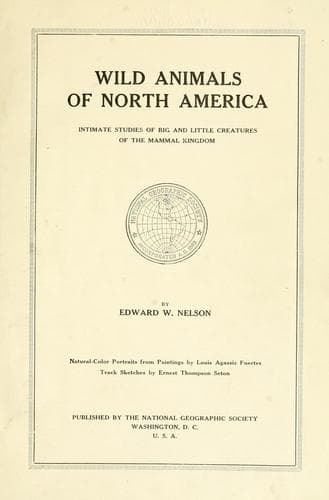
Wild Animals of North America: Intimate Studies of Big and Little Creatures of the Mammal KingdomNelson, Edward William
Science
Wild Animals of North America: Intimate Studies of Big and Little Creatures of the Mammal Kingdom
Nelson, Edward William
Mammals -- North America
The bucks usually keep by themselves during the summer, in parties
rarely exceeding ten. As their horns lose the velvet and the mating
season draws near, the old bucks gather in bands of from six to ten.
At this time they are in perfect physical condition, and a band of
them in the open forest, their antlers held proudly aloft and their
glossy coats shining in the sun, presents a superb picture. They have
little of the protective caution so characteristic of the white-tails,
and when a shot is fired at a band they often begin a series of
extraordinary “buck jumps,” bounding high in the air, facing this way
and that, sometimes not taking fight until after several additional
shots have been fired. These high, bounding leaps are characteristic of
mule deer and are commonly made when the animals are suddenly alarmed
and often when they are in full flight through brushy thickets.
After the mating season, bucks and does join in bands, sometimes of
fifteen or twenty, and descend to the foothills and sometimes even to
the adjacent plains. Their preference, however, is for rough and broken
country, such as that of canyon-cut mountains or the deeply scored
badlands of the upper Missouri River.
These deer are not good runners in the open. On several occasions, on
level country in Arizona, I have ridden after and readily overtaken
parties of them within a mile, their heaving flanks and open mouths
showing their distress. The moment rough country was reached, however,
with amazing celerity a series of mighty leaps carried them away from
me over declivities impossible for a horse.
The sight of a party of these splendid deer bounding away through the
aisles of a mountain forest always quickens one’s pulse and gives the
finishing touch of wildness to the scene. Mule deer are characteristic
animals of the beautiful open forests and forest parks of the Rocky
Mountains and the high Sierras, where they may be perpetuated if given
reasonable protection.
=BLACK-TAILED DEER= (=Odocoileus columbianus= and its
subspecies)
In general appearance the black-tails have a close resemblance to
the mule deer, but average smaller. They have the same large ears,
forked tines to the antlers, and rather “stocky” body; but the brushy
all-black tail distinguishes them from any other American deer. In
color they have much the same shade of brown as the Virginia deer.
They have the usual cycle of annual changes common to most American
deer--assuming a dull coat in fall and losing their horns in winter,
followed by the resumption of a brighter coat in spring and the renewal
of their horns in summer.
Public-domain text, read in full here on John Shaqi.
Reviews
Reviews
No reviews yet
Be the first to share your thoughts on this work.
Elsewhere in the archive
Join the Discussion
Join the discussion
Sign in to leave a comment or review.
Sign InorCreate an account