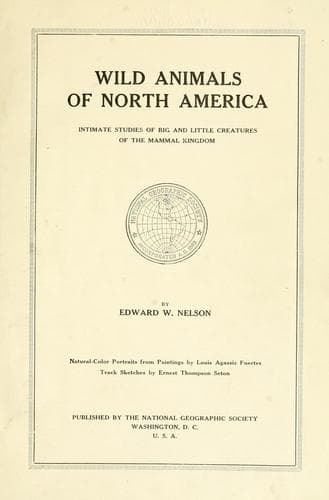
Wild Animals of North America: Intimate Studies of Big and Little Creatures of the Mammal KingdomNelson, Edward William
Science
Wild Animals of North America: Intimate Studies of Big and Little Creatures of the Mammal Kingdom
Nelson, Edward William
Mammals -- North America
Even beyond the limit of trees, on the desolate Arctic barrens, vast
herds containing hundreds of thousands of caribou drifted from one
feeding ground to another, sharing their range with numberless smaller
companies of musk-oxen. Despite the dwarfed and scanty vegetation of
this bleak region, the fierce winter storms and long arctic nights, and
the harrying by packs of white wolves, these hardy animals continued to
hold their own until the fatal influence of civilized man was thrown
against them.
Southward from the Arctic barrens, in the neighboring forests of
spruce, tamarack, birches, and aspens, were multitudes of woodland
caribou and moose. Still farther south, in the superb forests of
eastern North America, and ranging thence over the limitless open
plains of the West, were untold millions of buffalo, elk, and
white-tailed deer, with the prong-horned antelope replacing the
white-tails on the western plains.
With this profusion of large game, which afforded a superabundance
of food, there was a corresponding abundance of large carnivores, as
wolves, coyotes, black and grizzly bears, mountain lions, and lynxes.
Black bears were everywhere except on the open plains, and numerous
species of grizzlies occupied all the mountainous western part of the
continent.
Fur-bearers, including beavers, muskrats, land-otters, sea-otters,
fishers, martens, minks, foxes, and others, were so plentiful in the
New World that immediately after the colonization of the United States
and Canada a large part of the world’s supply of furs was obtained here.
Trade with the Indians laid the foundations of many fortunes, and later
developed almost imperial organizations, like the Hudson’s Bay Company
and its rivals. Many adventurous white men became trappers and traders,
and through their energy, and the rivalry of the trading companies,
we owe much of the first exploration of the northwestern and northern
wilderness. The stockaded fur-trading stations were the outposts of
civilization across the continent to the shores of Oregon and north
to the Arctic coast. At the same time the presence of the sea-otter
brought the Russians to occupy the Aleutian Islands, Sitka, and even
northern California.
[Illustration:
Photograph by Capt. F. E. Kleinschmidt
TOWING HER BABY TO SAFETY
When a mother polar bear scents danger she jumps into the water and her
cub holds fast to her tail while she tows it to safety. But when no
danger seems to threaten she wants it to “paddle its own canoe,” and
boxes its ears or ducks its head under water if it insists on being too
lazy to swim for itself.]
Public-domain text, read in full here on John Shaqi.
Reviews
Reviews
No reviews yet
Be the first to share your thoughts on this work.
Join the Discussion
Join the discussion
Sign in to leave a comment or review.
Sign InorCreate an account