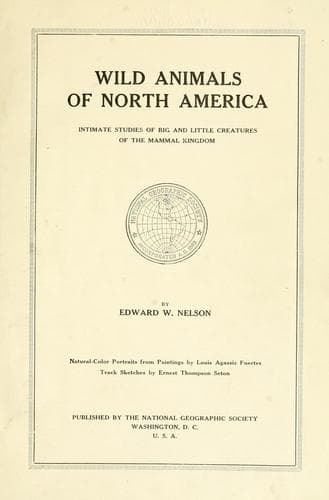
Wild Animals of North America: Intimate Studies of Big and Little Creatures of the Mammal KingdomNelson, Edward William
Science
Wild Animals of North America: Intimate Studies of Big and Little Creatures of the Mammal Kingdom
Nelson, Edward William
Mammals -- North America
The supreme importance of this deer to the early settlers of the
Eastern States is made plain in all the literature covering the
occupation of that region. Its flesh was one of the most reliable
staples in the food supply, and not infrequently was the only resource
against starvation. In addition, the tanned skins served for clothing
and the sinews for thread. Many of the most striking and romantic
characters in our early history appear clad in buckskin, from fringed
hunting shirt to beaded moccasins.
As no other American game animal equaled the white-tail in economic
value to the settlers, so even to-day it remains the greatest game
asset in many of the Eastern States. Partly through protective laws and
partly through its acute intelligence and adaptability, the Virginia
deer continues to hold its own in suitable woodland areas throughout
most of its former range, and in recent years has pushed hundreds of
miles northward into new territory in Ontario and Quebec.
Even in the oldest and most densely populated States, as New York and
Massachusetts, white-tails still exist in surprising numbers. Over
7,000 were killed during the hunting season of 1915 in Maine, and
an average of about 2,800 are killed yearly in Vermont. The great
recreational value of the white-tail to a host of sportsmen is obvious.
To the growing multitude of nature lovers the knowledge that a forest
is inhabited by deer immediately endows it with a delightful and
mysterious charm.
In summer white-tails are usually solitary or wander through the forest
in parties of two or three. In winter, where the snowfall is heavy,
they gather in parties, sometimes of considerable size, in dense
deciduous growth, where food is plentiful. There they remain throughout
the season, forming a “yard” by keeping a network of hard-beaten paths
open through the snow in order to reach the browse afforded by the
bushes and trees.
Ordinarily Virginia deer are shy and elusive habitants of dense
forests, where they evade the unpracticed intruder like noiseless
shadows. Where they are strictly protected for a period of years under
State laws, they become surprisingly confident and often damage young
orchards and crops on farms near their haunts. Several States pay for
the damage thus done. Happily this attractive species thrives so well
under protective laws that its continued future in our forests appears
to be assured.
ARIZONA WHITE-TAILED DEER (Odocoileus couesi)
The Arizona white-tails are slight and graceful animals, like pigmy
Virginia deer, so small that hunters often ride into camp with a
full-grown buck tied back of the saddle. They have two seasonal
pelages--gray in winter and more rusty brown in summer. The antlers,
very small, but in form similar to those of the Virginia deer, are shed
in winter and renewed before the end of summer.
Public-domain text, read in full here on John Shaqi.
Reviews
Reviews
No reviews yet
Be the first to share your thoughts on this work.
Elsewhere in the archive
Join the Discussion
Join the discussion
Sign in to leave a comment or review.
Sign InorCreate an account