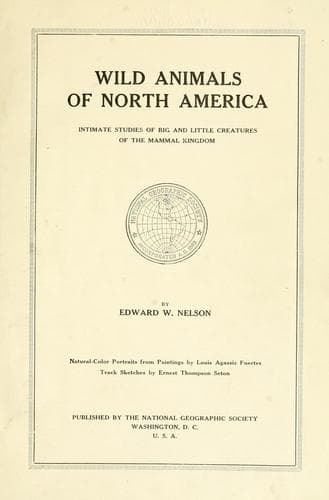
Wild Animals of North America: Intimate Studies of Big and Little Creatures of the Mammal KingdomNelson, Edward William
Science
Wild Animals of North America: Intimate Studies of Big and Little Creatures of the Mammal Kingdom
Nelson, Edward William
Mammals -- North America
The black-tails have one of the most restricted ranges among our deer.
They are limited to the humid heavily forested belt along the Pacific
coast from Juneau, Alaska, southward to the Coast range in central
California. This coastal belt is characterized by superb growths of
cedars, spruces, and firs in the north and by redwoods and firs in the
south, uniting to make one of the most magnificent forest areas in the
world. Here the deer live in the midst of rank undergrowths of gigantic
ferns and other vegetation, as luxuriant in many places as that of the
humid tropics.
Their home on the abruptly rising slopes of the islands in the Alaskan
Archipelago is so restricted that both in summer and winter they fall
an easy prey to native and white hunters. It has been reported that
there has been much wasteful killing of the deer on these islands for
commercial purposes. When the heavy snows of winter on the islands
force the deer down to the shore, great numbers of them are also killed
by wolves.
Black-tails commonly have two or three young, and this fecundity,
combined with the effective protection given by the dense forest where
many of them live, will aid in their perpetuation. At the same time
they have not developed the mental alertness of the Virginia deer, and
there is imminent need for prompt and effective action in safeguarding
the deer in the Alaskan part of their range if their extermination on
some of the islands is to be prevented. In this northern region the
black-tails share their range with strange tribes of coastal Indians,
whose huge sea-going canoes, totem poles, and artistic carvings are
unique among native Americans.
=VIRGINIA, OR WHITE-TAILED, DEER= (=Odocoileus virginianus=
and its subspecies)
The aptness of the name “white-tail” for the Virginia deer is obvious
to any one who has startled one in the forest and seen it dash away
with the tail upright and flashing vivid white signals at every leap.
The adults have two strongly contrasted coats each year: brownish gray
in winter and rusty red in summer. The fawns, usually two in number,
are dull rusty brown, marked with a series of large white spots, which
remain until the gray winter coat is assumed in the fall. Large bucks
sometimes attain a weight of more than 300 pounds.
The white-tail is the well-known deer of all the forest areas in
eastern North America. With its close relatives, it ranges from
northern Ontario to Florida and from the Atlantic coast to the Great
Plains; also in the Rocky Mountains south to New Mexico, and in the
Cascades and Sierra Nevada to northern California.
Public-domain text, read in full here on John Shaqi.
Reviews
Reviews
No reviews yet
Be the first to share your thoughts on this work.
Elsewhere in the archive
Join the Discussion
Join the discussion
Sign in to leave a comment or review.
Sign InorCreate an account