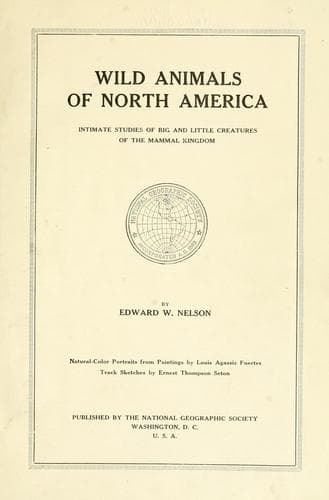
Wild Animals of North America: Intimate Studies of Big and Little Creatures of the Mammal KingdomNelson, Edward William
Science
Wild Animals of North America: Intimate Studies of Big and Little Creatures of the Mammal Kingdom
Nelson, Edward William
Mammals -- North America
The caribou lacks the symmetry and grace of the true deer. Its large
head topped with irregular antlers, heavy body, and thick, sturdy legs,
ending in large, broad-spreading hoofs, produce a distinctly ungainly
animal. It is the only member of the deer family in which both sexes
have antlers, those of the female being smaller and slenderer than
those of the male. It varies in size in different parts of its range,
but large old bulls usually weigh from 300 to 400 pounds. A single calf
is the rule, but occasionally there are two.
The woodland caribou, the southern representative of the barren ground
caribou, inhabits almost the same northern forest of spruce, tamarack,
birch, and alder as those sheltering the moose. It ranges from the
northern border of the forests in Alaska and Canada south to Maine,
northern Minnesota, northern Idaho, and British Columbia. It is far
less gregarious than the barren ground caribou, during summer only
small parties of cows, calves, and partly grown young keeping together,
while the bulls are solitary or in still smaller separate parties. In
winter all unite in larger herds.
The curiously ungraceful appearance of the caribou, so different from
other deer, gives it a strong individuality, which seems to belong
with its remote haunts in the wilderness. This great animal has an
added appeal to our interest, owing to its close relationship to that
other woodland caribou which was such an important resource to the
cave-men of France and other parts of Europe, as shown by bone and horn
implements, carvings, and other records discovered in their homes.
During summer and fall in eastern Canada, where this caribou is
distributed through much of the wilder forests, it has a habit of
coming out of the woods to sun itself and bathe on the borders of
shallow lakes. Here the old bulls wallow in the water, and on rising
shake themselves like a dog, filling the air with a halo of sparkling
water drops. In such places the bulls frequently stand basking in the
sun for hours. To a canoeman gliding silently around a jutting point,
this rugged habitant of the wilds, discovered across the shining
waters, standing outlined against the dark green forest, represents a
wonderfully picturesque sight. When alarmed at such times the caribou
dashes shoreward through the water amid clouds of flying spray struck
up by its broad feet and vanishes in the sheltering forest, accompanied
by a loud crashing of dry branches.
Public-domain text, read in full here on John Shaqi.
Reviews
Reviews
No reviews yet
Be the first to share your thoughts on this work.
Elsewhere in the archive
Join the Discussion
Join the discussion
Sign in to leave a comment or review.
Sign InorCreate an account