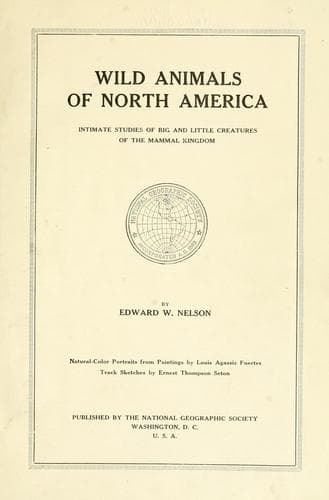
Wild Animals of North America: Intimate Studies of Big and Little Creatures of the Mammal KingdomNelson, Edward William
Science
Wild Animals of North America: Intimate Studies of Big and Little Creatures of the Mammal Kingdom
Nelson, Edward William
Mammals -- North America
The woodland caribou is neither so swift nor so astute in avoiding
danger as the Virginia deer or the moose. It falls an easy prey to
hunters and to wolves, and when not properly safeguarded is readily
exterminated. This is shown by its complete disappearance from the
Adirondacks, in northern New York, and by its threatened disappearance
from the forests of Maine, Minnesota, and Idaho; in fact, the woodland
caribou is in more imminent danger of complete and early extermination
within the United States than any other game animal and can be saved
only by stringent laws and careful guardianship.
=BARREN GROUND CARIBOU= (=Rangifer arcticus= and its
subspecies) (see illustration, page 422).
The typical barren ground caribou is smaller and paler colored than the
woodland species. Several geographic races have been distinguished,
among which the most notable is the Peary caribou, the palest of all
and the subject of the accompanying drawing. Like other members of the
group, this species is a heavily built animal, with thick legs and
large feet.
The barren ground caribou is characteristic of the desolate Arctic
barrens and tundras beyond the limit of trees, ranging to the
northernmost limit of land beyond 83 degrees of latitude. When
explorers first visited these northern wilds, including the treeless
coastal belt from the Peninsula of Alaska to Bering Straits, they
found these animals almost everywhere in extraordinary abundance. Over
great areas of this territory straggling herds of caribou, sometimes
numbering hundreds of thousands, drifted with the season from one
feeding ground to another.
The advent of white men with guns has resulted in their rapid decrease
everywhere and in their extermination over great areas. In many of
their old haunts the only trace of their former abundance is in
well-marked trails winding by easy grades to the bare tops of the low
mountains. They are still numerous on the Peninsula of Alaska and in
much greater numbers in parts of the barren grounds of Canada. There,
on the shores of Artillery Lake, during the summer of 1907 a small
migrating herd of about 2,000 was seen.
When alarmed these caribou often break into a clumsy gallop, which
soon changes to a steady shambling trot, their characteristic gait,
carrying them rapidly across country. In winter their tracks in the
snow show that their feet, instead of being raised high at each step,
like those of a Virginia or mule deer, drag through the snow like those
of domestic cattle. Their large, broad-spreading hoofs, with sharp,
cup-shaped edges, are admirably adapted to secure a firm footing in the
yielding and hummocky surface of their haunts in summer and on the snow
and ice in winter.
Public-domain text, read in full here on John Shaqi.
Reviews
Reviews
No reviews yet
Be the first to share your thoughts on this work.
Elsewhere in the archive
Join the Discussion
Join the discussion
Sign in to leave a comment or review.
Sign InorCreate an account