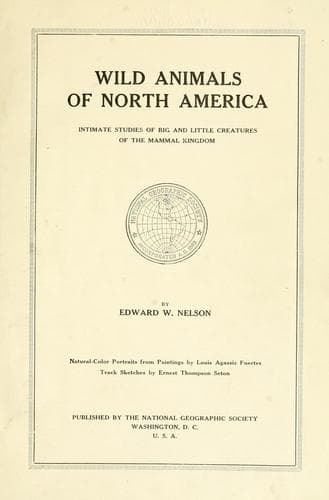
Wild Animals of North America: Intimate Studies of Big and Little Creatures of the Mammal KingdomNelson, Edward William
Science
Wild Animals of North America: Intimate Studies of Big and Little Creatures of the Mammal Kingdom
Nelson, Edward William
Mammals -- North America
The moose inhabits our northern forests, where it wanders among
thickets of spruce, tamarack, birch, aspen, and alder, from the mouth
of the Yukon and the lower Mackenzie southward to Maine, northern
Minnesota, and down the Rocky Mountains to Wyoming. It varies in size
in different parts of its range. The bulls of the Kenai Peninsula and
adjacent region in Alaska are the largest of their kind in the world,
sometimes weighing more than 1,400 pounds. The enormous antlers of
these great northern beasts attain a spread of more than six feet
and make the most impressive trophy the big-game hunter can secure in
America.
Although taller than an ordinary horse, weighing more than half a ton,
and adorned with wide-spreading antlers, the bull moose stalks with
ghostly silence through thickset forests, where man can scarcely move
without being betrayed by the loud crackling of dry twigs. In summer
it loves low-lying, swampy forests interspersed with shallow lakes and
sluggish streams. In such places it often wades up to its neck in a
lake to feed on succulent water plants, and when reaching to the bottom
becomes entirely submerged. These visits to the water are sometimes by
day, but usually by night, especially during the season when the calves
are young and the horns of the bulls are but partly grown.
Late in the fall, with full-grown antlers, the bulls wander through the
forest looking for their mates, at times uttering far-reaching calls of
defiance to all rivals, and occasionally clashing their horns against
the saplings in exuberance of masterful vigor. Other bulls at times
accept the challenge and hasten to meet the rival for a battle royal.
At this season the call of the cow moose also brings the nearest bulls
quickly to her side. Hunters take advantage of this, and by imitating
the call through a birch-bark trumpet bring the most aggressive bulls
to their doom.
Ordinarily moose are extremely shy, but during the mating season the
males become so bold that when encountered at close range they have
been known furiously to charge a hunter. They strike vicious blows
with their front feet, as well as with their heavy antlers, and make
dangerous foes for man or beast.
Moose have disappeared from the Adirondacks and have become scarce
in many districts where once plentiful. Through wise protection they
are still numerous about the head of Yellowstone Lake, and are still
among the available game animals of Maine and the eastern provinces of
Canada. Indeed, during the last few years they have steadily extended
their range in northern Ontario and British Columbia. They occupy great
areas of little-visited wilderness, which are becoming more and more
accessible; as a result the future existence of these superb animals
depends upon their receiving proper protection.
=AMERICAN BISON= (=Bison bison= and its subspecies)
Public-domain text, read in full here on John Shaqi.
Reviews
Reviews
No reviews yet
Be the first to share your thoughts on this work.
Elsewhere in the archive
Join the Discussion
Join the discussion
Sign in to leave a comment or review.
Sign InorCreate an account