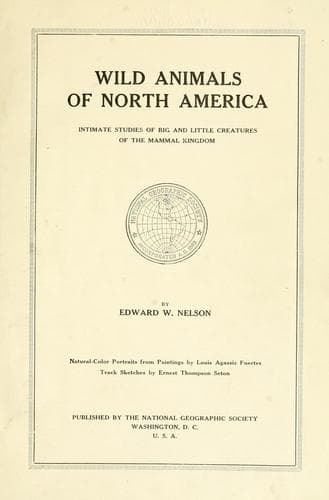
Wild Animals of North America: Intimate Studies of Big and Little Creatures of the Mammal KingdomNelson, Edward William
Science
Wild Animals of North America: Intimate Studies of Big and Little Creatures of the Mammal Kingdom
Nelson, Edward William
Mammals -- North America
The American bison, or buffalo, is a close relative of the larger bison
which once inhabited Europe and survives in limited numbers in certain
game preserves of Poland and the Caucasus. The size, dark shaggy coat,
great head, and high arched shoulders of our bison give them a unique
individuality among American big game. They once roamed in vast numbers
over a broad territory, extending from Great Slave Lake, Canada, south
to southern New Mexico, and from Pennsylvania and eastern Georgia to
Arizona and northern Nevada. It is thus evident that they were at
home in the forested country east of the Mississippi River, as well as
on the treeless plains of the West. In the northern part of their range
they are larger and darker than elsewhere and form a local geographic
race called the wood buffalo.
[Illustration: MOOSE]
[Illustration: AMERICAN BISON, OR BUFFALO]
Originally buffalo were enormously abundant in America, and it has been
variously estimated that when the continent was first discovered their
numbers were from 30,000,000 to 60,000,000. With the settlement of
eastern America, they gradually retreated across the Mississippi River,
but continued to exist in great but rapidly diminishing numbers on the
Great Plains up to within the last fifty years.
The crossing of their range by the first transcontinental railroad
quickly brought the remaining herds to an end. In 1870 there were
still about 5,500,000 head on the plains, but these were so wastefully
slaughtered for their hides that in 1895 only about 800 remained. The
depletion of the herds was so startling that sportsmen and nature
lovers awoke to the danger of the immediate extermination of these
splendid animals; the American Bison Society was organized and the
surviving buffalo were saved.
Although the bison usually has but a single calf a year, these are
so hardy and do so well in fenced preserves, and even in the closer
confinement of small parks, that their number has now increased to
approximately 4,000, about equally divided between the United States
and Canada. In the district south of Artillery Lake, northern Canada,
a few hundred individuals, remnants of the wild stock of that region,
survive and are increasing under the wise protection of the Canadian
Government. The only other herd still existing on its original ground
is that in Yellowstone National Park.
Experiments have been made in crossing buffalo with certain breeds
of domestic cattle for the purpose of establishing a new and hardier
variety of stock for the Western ranges. These have not proved
successful, largely owing to the lack of fertility in the hybrid, which
has been called the “cattalo.”
Public-domain text, read in full here on John Shaqi.
Reviews
Reviews
No reviews yet
Be the first to share your thoughts on this work.
Elsewhere in the archive
Join the Discussion
Join the discussion
Sign in to leave a comment or review.
Sign InorCreate an account