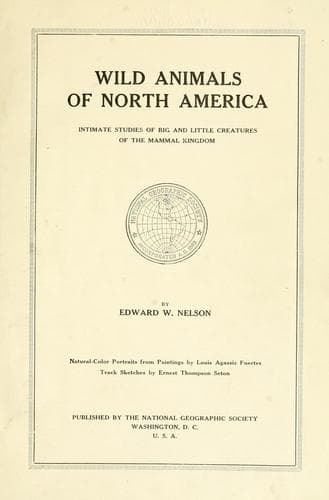
Wild Animals of North America: Intimate Studies of Big and Little Creatures of the Mammal KingdomNelson, Edward William
Science
Wild Animals of North America: Intimate Studies of Big and Little Creatures of the Mammal Kingdom
Nelson, Edward William
Mammals -- North America
Killers are like giant wolves of the sea, and their ferocity strikes
terror to the other warmblooded inhabitants of the deep. The Eskimos of
the Alaskan coast of Bering Sea consider killers as actual wolves in
sea form. They believe that in the early days, when the world was young
and men and animals could change their forms at will, land wolves often
went to the edge of the shore ice and changed to killer whales, and
the killers returned to the edge of the ice and climbed out as wolves,
to go ravening over the land. Some of the natives assured me that even
today certain wolves and killers are still endowed with this power and,
on account of their malignant character, are much feared by hunters.
Killers are known to swallow small seals and porpoises entire and
attack large whales by tearing away their fleshy lips and tongues.
When attacking large prey they work in packs, with all the unity and
fierceness of so many wolves. The natives of the Aleutian Islands told
me that large skin boats are sometimes lost in the passes between the
islands by sea-lions leaping upon them in their frenzied efforts to
escape the pursuit of killer whales.
The killers are specially detrimental to the fur-seal industry, owing
to their habit of preying upon seals during their migrations in the
North Pacific and during the summer in Bering Sea. They also haunt the
waters about the Fur Seal Islands to continue their depredations during
the summer. It would be a wise conservation measure for the Federal
Government to have these destructive beasts persistently hunted and
destroyed each spring and summer when they congregate on the north side
of the Aleutian passes. Their destruction would not only save large
numbers of fur seals, but would undoubtedly protect the few sea otters
still remaining in those waters.
WHITE WHALE, OR BELUGA (Delphinapterus leucas)
The white whale, or beluga of the Russians, is a circumpolar species,
limited to the extreme northern coasts of the Old and the New Worlds.
The adult is entirely of a milk-white color, is very conspicuous, and
as it comes up to “blow” presents an interesting sight. The young
beluga is dark slate color, becoming gradually paler for several years
until it attains its growth. The beluga usually lives in the shallow
waters along shore, and not only frequents sheltered bays and tidal
streams, but ascends rivers for considerable distances. Plentiful along
the coast of Alaska, especially in Bering Sea and the Arctic Ocean,
this whale also ascends the Yukon for a long distance. It also comes
down the Atlantic coast and enters the lower St. Lawrence River.
Public-domain text, read in full here on John Shaqi.
Reviews
Reviews
No reviews yet
Be the first to share your thoughts on this work.
Elsewhere in the archive
Join the Discussion
Join the discussion
Sign in to leave a comment or review.
Sign InorCreate an account