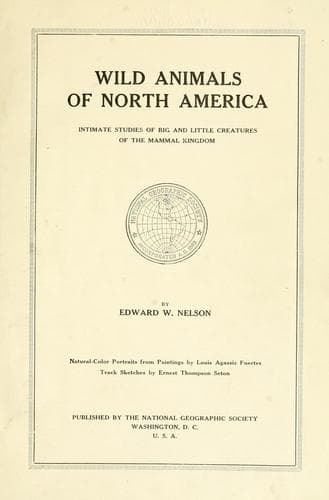
Wild Animals of North America: Intimate Studies of Big and Little Creatures of the Mammal KingdomNelson, Edward William
Science
Wild Animals of North America: Intimate Studies of Big and Little Creatures of the Mammal Kingdom
Nelson, Edward William
Mammals -- North America
The Florida manatis are extremely mild and inoffensive animals, seeming
never to fight one another, nor to show aggressiveness of any kind.
When not molested they are very gentle and will feed close about a boat
or dock regardless of the presence of people, but they become alarmed
by any sudden noise. In captivity they soon learn to eat from their
captor’s hands.
Manatis are sluggish, stupid animals, without other defense than
their size. They are not rapid swimmers and are among the extremely
few herbivorous aquatic mammals. Unlike seals, whales, and their
allies, which feed upon some form of animal life, manatis feed on the
lush grasses and other vegetation springing from the oozy bottom of
the waters they frequent. When feeding on the bottom they use their
flippers to help move slowly about. In places along the Indian River
they are reported to approach the shore and, with head and shoulders
out of water, to feed on heavy grasslike plants hanging from the banks.
[Illustration: MUSK-OX]
While they are feeding the heavy bi-lobed upper lips work freely and
are sufficiently prehensile to seize the grass, or other plant food,
between the lobes and thrust it back into the mouth. The ends of the
flippers are sometimes used to help convey food to the mouth, like huge
hands in thumbless mittens.
[Illustration: FLORIDA MANATI]
When suckling her young the manati rises to the surface, her head and
shoulders out of the water, and with her flippers holds the nursling
partly clasped to her breast. This semi-human attitude, together with
the rounded head and fishlike tail, may have furnished the basis on
which the ancients built their legends of the mermaids.
KILLER WHALE (Orcinus orca)
The killer whale is a habitant of all oceans from the border of the
Arctic ice fields to the stormy glacial margin of the Antarctic
continent. So far as definitely known, there appears to be but a single
species. It attains an extreme length of approximately 30 feet and is
mainly black with well-defined white areas on the sides and underparts
of the body. Its most striking and picturesque characteristic is the
large black fin, several feet long, standing upright on the middle of
the back.
The killer usually travels and hunts in “schools” or packs of from
three to a dozen or more individuals. Unlike most whales, the members
of these schools do not travel in a straggling party, but swim side
by side, their movements as regularly timed as those of soldiers. A
regularly spaced row of advancing long black fins swiftly cutting the
undulating surface of the sea produces a singularly sinister effect.
The evil impression is well justified, since killers are the most
savage and remorseless of whales. The jaws are armed with rows of
effective teeth, with which the animals attack and devour seals and
porpoises, and even destroy some of the larger whales.
Public-domain text, read in full here on John Shaqi.
Reviews
Reviews
No reviews yet
Be the first to share your thoughts on this work.
Elsewhere in the archive
Join the Discussion
Join the discussion
Sign in to leave a comment or review.
Sign InorCreate an account