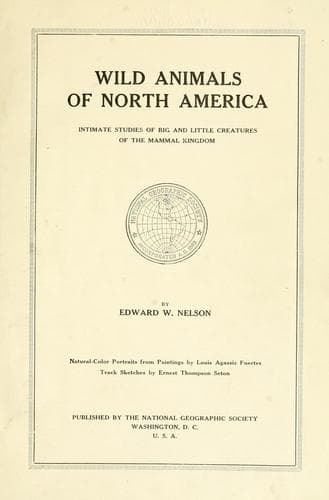
Wild Animals of North America: Intimate Studies of Big and Little Creatures of the Mammal KingdomNelson, Edward William
Science
Wild Animals of North America: Intimate Studies of Big and Little Creatures of the Mammal Kingdom
Nelson, Edward William
Mammals -- North America
The northern seas frequented by these whales swarm with small, almost
microscopic, crustaceans and other minute pelagic life, which is
commonly so abundant that great areas of the ocean are tinged by them
to a deep brown. These gatherings of small animal life are called
“brit” by the whalers and furnish the food supply of the bowhead. The
whale swims slowly through the sea with its mouth open, straining the
water through the fringed whalebone plates on each side of its mouth,
thus retaining on its enormous fleshy tongue a mass of “brit,” which
is swallowed through a gullet extraordinarily small in comparison with
the size of the mouth. Among all the animal life on the earth there is
not a more perfectly developed apparatus provided for feeding on highly
specialized food than that possessed by the right whale--one of the
hugest of beasts and feeding on some of the smallest of animals, untold
numbers of which are required for a single mouthful.
The bowhead is a circumpolar species, which in summer frequents the
Arctic ice pack and its borders, and on the approach of winter migrates
to a more-southerly latitude. For centuries this huge mammal has formed
the main basis for the whaling industry in far northern waters, first
in the Greenland seas and later through Bering Straits into the Arctic
basin north of the shores of Siberia and Alaska.
Each large whale is a prize worth winning, since it may yield as
much as 200 barrels of oil and several thousand pounds of whalebone.
All know of the rise and fall of the whaling business, on which many
fortunes were built and on which depended the prosperity of several New
England towns.
Whaling served to train a hardy and courageous generation of sailors
the like of which can nowhere be found today. They braved the perils of
icy seas in scurvy-ridden ships, and when fortune favored brought to
port full cargoes of “bone” and oil, which well repaid the hardships
endured in their capture. Many a ship and crew sailed into the North in
pursuit of these habitants of the icy sea never to return.
Interest in the brave and romantic life of the whalers still exists,
though the most picturesque quality of their calling passed with the
advent of steam whalers and the “bomb gun,” which shoots an explosive
charge into the whale and kills it without the exciting struggle which
once attended such a capture by open boats.
It has been well said that no people ever advanced in the scale of
civilization without the use of some artificial illuminant at night.
The world owes a great debt to the right whale and its relatives for
their contribution to the “midnight oil,” which encouraged learning
through the centuries preceding the discovery of mineral oil. It also
furnished the whalebone which built up the “stays” so dear to the
hearts of our great-grandmothers.
Public-domain text, read in full here on John Shaqi.
Reviews
Reviews
No reviews yet
Be the first to share your thoughts on this work.
Elsewhere in the archive
Join the Discussion
Join the discussion
Sign in to leave a comment or review.
Sign InorCreate an account