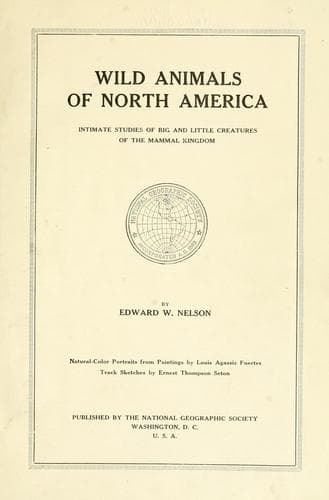
Wild Animals of North America: Intimate Studies of Big and Little Creatures of the Mammal KingdomNelson, Edward William
Science
Wild Animals of North America: Intimate Studies of Big and Little Creatures of the Mammal Kingdom
Nelson, Edward William
Mammals -- North America
The female right whale has a single young, which she suckles and keeps
with her for about a year. She shows much maternal affection, and a
number of cases are recorded in which the mother persisted in trying to
release her young after it had been harpooned and killed.
Every year, as the pack ice breaks up for the season, the bowheads move
north through Bering Straits. As late as 1881 Eskimos along the Arctic
coast of Alaska put to sea in walrus-hide umiaks, armed with primitive
bone-pointed spears, seal-skin floats, and flint-pointed lances for the
capture of these huge beasts. These fearless sea hunters, with their
equipment handed down from the Stone Age, were sufficiently successful
in their chase to cause trading schooners to make a practice of
visiting the villages along the coast to buy their whalebone.
From one of the whaling ships encountered north of Bering Straits the
summer of 1881 we secured a harpoon, taken from a bowhead in those
waters, bearing a private mark which proved that it came from a whaling
ship on the Greenland coast, thus showing conclusively that these
whales in their wanderings make the “Northwest Passage.”
Persistent hunting through the centuries has vastly decreased whales of
all valued species, and the modern steam whaler is hastening their end.
Their only hope of survival lies in wise international action, and it
is urgent that this be secured in time.
[Illustration: KILLER WHALE]
[Illustration: WHITE WHALE, OR BELUGA]
[Illustration: GREENLAND RIGHT WHALE, OR BOWHEAD]
[Illustration: SPERM WHALE, OR CACHALOT]
SPERM WHALE, OR CACHALOT (Physeter macrocephalus)
The cachalot is from 40 to 60 feet long, about equaling the Greenland
bowhead whale in size. It has a huge blunt head, which comprises about
one-third of the entire animal. The mouth is large and the under jaw is
provided with a row of heavy teeth, consisting of ivory finer in grain
than that from an elephant’s tusk.
The great whaling industry of the last two centuries was based mainly
on the sperm and the bowhead whales. The largest of the bowheads is
limited to the cold northern waters, but the sperm whale frequents
the tropic and subtropic seas around the globe. The main hunting area
for them lies in the South Pacific, but they frequently visit more
temperate coasts, especially when seeking sheltered bays, where their
young may be born. The young are suckled and guarded carefully until
old enough to be left to their own devices. Sperm whales sometimes
occur off both coasts of the United States, especially off southern
California.
The feeding grounds of these whales are mainly in the deepest parts
of the ocean, where they cruise about in irregular schools containing
a number of individuals. Their food consists almost entirely of large
octopuses and giant squids, which are swallowed in large sections.
Public-domain text, read in full here on John Shaqi.
Reviews
Reviews
No reviews yet
Be the first to share your thoughts on this work.
Elsewhere in the archive
Join the Discussion
Join the discussion
Sign in to leave a comment or review.
Sign InorCreate an account