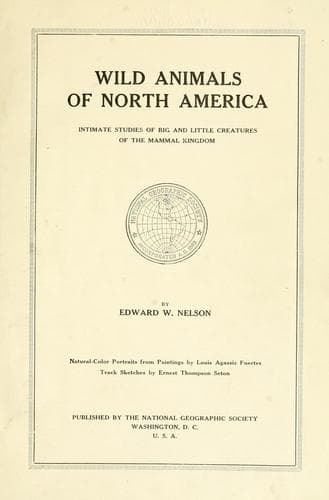
Wild Animals of North America: Intimate Studies of Big and Little Creatures of the Mammal KingdomNelson, Edward William
Science
Wild Animals of North America: Intimate Studies of Big and Little Creatures of the Mammal Kingdom
Nelson, Edward William
Mammals -- North America
Wolf, Prairie, or Plains Coyote 424 423
Wolf, Timber or Gray 421 423
Wolverine 428 427
SMALLER MAMMALS OF NORTH AMERICA
BY EDWARD W. NELSON
CHIEF, U. S. BIOLOGICAL SURVEY
_With illustrations in color from paintings by Louis Agassiz Fuertes_
In that part of North America lying north of Mexico more than 1,300
species and geographic races of mammals are known to exist. Of these by
far the greater number, both of species and individuals, fall into the
class of smaller mammals.
Some of the most characteristic types which appear to have originated
in North America are the mountain-beavers, pocket-gophers,
kangaroo-rats, pocket-mice, wood-rats, white-footed mice, muskrats,
skunks, and ring-tailed cats.
In Siberia and Europe live close counterparts of our northern weasels,
minks, martens, field-mice, lemmings, northern hares, conies, marmots,
moles, and others; and on our southern border the armadillo and the
hog-nosed skunk introduce a faint tinge of a strange fauna from South
America.
FURRY FRIENDS AND ENEMIES
The muskrats, minks, martens, and skunks for many years have yielded
an enormous annual return from their furs; the squirrels and rabbits
afford sport and a large supply of excellent flesh for food; the
prairie-dogs and some of the ground-squirrels existing in enormous
numbers have been excessively destructive to crops; and others, like
the porcupine and the armadillo, have attracted particular attention
because of their strange characteristics.
ANIMALS THAT LEARNED TO “DIG IN”
The smaller mammals live everywhere, from the tropical end of Florida
to the uttermost lands of the frozen North, and from the seashore to
the limit of vegetation on the high mountains. The heaviest forests,
open meadows, rugged mountain slopes, arctic barrens, and sun-scorched
desert plains all have their small four-footed habitants. Many
modifications of parts and organs of the various species have been
necessary to adapt the small mammals to specialized modes of life.
This is strikingly illustrated in the case of those true rodents, the
pocket-gophers, which apparently found competition on the surface of
the ground so acute that they took the unoccupied territory below the
surface, where they live as miners and tunnel from place to place in
search of edible roots, with an occasional stealthy excursion above
ground to seize some of the food available there.
Another excellent illustration is furnished by the moles, which,
leaving the numerous closely related species--the shrews--to feed upon
insects above ground, have descended and, like the pocket-gophers,
live in tunnels which they make in the pursuit of earthworms and
insects below the surface; like the gophers, they, too, make occasional
excursions above ground in search of food.
Public-domain text, read in full here on John Shaqi.
Reviews
Reviews
No reviews yet
Be the first to share your thoughts on this work.
Elsewhere in the archive
Join the Discussion
Join the discussion
Sign in to leave a comment or review.
Sign InorCreate an account