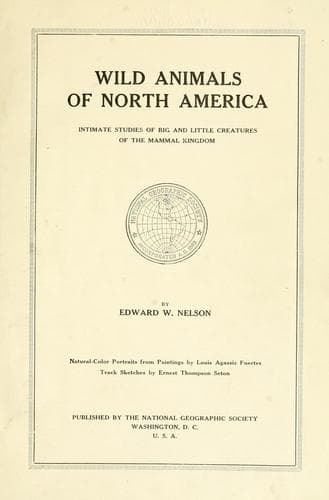
Wild Animals of North America: Intimate Studies of Big and Little Creatures of the Mammal KingdomNelson, Edward William
Science
Wild Animals of North America: Intimate Studies of Big and Little Creatures of the Mammal Kingdom
Nelson, Edward William
Mammals -- North America
The mink and the muskrat, representing the carnivores and rodents, have
rivals for their food supply on land and have become amphibious, being
as much at home in the water as on shore, one feeding on fish and flesh
and the other on aquatic vegetation. Certain forms of the squirrel
tribe are heavy-bodied and live in underground burrows, while other
more slender and graceful species make their homes in the tree-tops.
A DEPARTURE FOR EVERY NEED
Another member of this group, the flying-squirrel, has developed an
extension of the skin uniting the front and hind legs, so it may glide
freely from tree to tree. The bats have gone still further, and the
skin uniting their lengthened front and hind limbs and long finger
bones forms broad wings which lend them powers of flight scarcely
equaled by those of birds.
The gophers, pocket-mice, chipmunks, and others are provided with
little cheek pouches in the skin on each side of the mouth, in which
they may carry food home to their store-rooms and other hiding places.
[Illustration:
Photograph by Howard Taylor Middleton
HEREDITARY ENEMIES: A CAT WATCHING A GRAY SQUIRREL
At one time the gray squirrel was so abundant as to make ruinous
inroads on the corn and wheat crops of our pioneers. In Ohio, a hundred
years ago, there was a law requiring each free white man to deliver
100 squirrel scalps every year or pay a penalty of $3. Today the gray
squirrel needs legal protection to prevent its extermination.]
The hares have developed long legs for running on open plains, and the
weasels have long, slender bodies and an exceeding quickness which
enables them to follow and capture their elusive prey in its burrows
and among crevices in the rocks.
The hairy coat of the mole is short and equal to the finest velvet,
while that of the porcupine stands out in strong, sharp spines; the
skin of the armadillo is practically hairless, but forms a bony armor
covering its upper parts.
The front feet of squirrels and most other rodents are slender and used
with deftness as hands in manipulating food, while those of the badger
and skunk are heavily clawed and strongly muscled for the purpose of
digging up their prey.
The tails of many species are varied in form to serve special purposes.
The long-haired tails of tree-squirrels have a plume-like character,
which adds much to the beauty of these attractive animals. The long
tails of the kangaroo-rats and the jumping-mice serve as balances for
their bodies during long leaps. The vertically flattened tail of the
muskrat and the broad horizontally flattened tail of the beaver are
useful as rudders. Perhaps the oddest of all is the naked prehensile
tail of the opossum, which coils about branches or other support and
thus is a safeguard against a possible fall, and even permits the
animal to hang suspended by it alone.
STRANGE ADAPTATIONS TO MEET CONDITIONS OF ENVIRONMENT AND COMPETITION
Public-domain text, read in full here on John Shaqi.
Reviews
Reviews
No reviews yet
Be the first to share your thoughts on this work.
Elsewhere in the archive
Join the Discussion
Join the discussion
Sign in to leave a comment or review.
Sign InorCreate an account