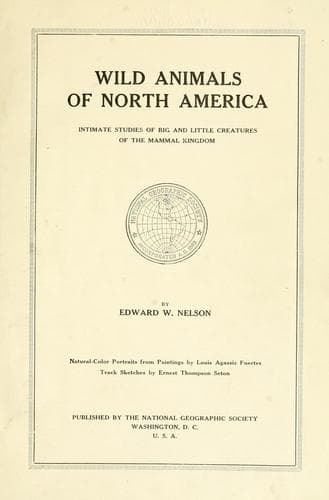
Wild Animals of North America: Intimate Studies of Big and Little Creatures of the Mammal Kingdom — John Shaqi
Wild Animals of North America: Intimate Studies of Big and Little Creatures of the Mammal KingdomNelson, Edward William
Science
Wild Animals of North America: Intimate Studies of Big and Little Creatures of the Mammal Kingdom
Nelson, Edward William
Mammals -- North America
“Up to within a few years, in northern Montana and southern Alberta,
old buffalo trails have been very readily traceable by the eye, even
as one passed on a railroad train. These trails, fertilized by the
buffalo and deeply cut so as to long hold moisture, may still be seen
in summer as green lines winding up and down the hills to and from the
water-courses.”
Concerning the former abundance of antelope, Dr. Grinnell says: “For
many years I have held the opinion that in early days on the plains,
as I saw them, antelope were much more abundant than buffalo. Buffalo,
of course, being big and black, were impressive if seen in masses and
were visible a long way off. Antelope, smaller and less conspicuous in
color, were often passed unnoticed, except by a person of experience,
who might recognize that distant white dots might be antelope and not
buffalo bones or puff balls. I used to talk on this subject with men
who were on the plains in the ’60’s and ’70’s, and all agreed that,
so far as their judgment went, there were more antelope than buffalo.
Often the buffalo were bunched up into thick herds and gave the
impression of vast numbers. The antelope were scattered, and, except in
winter, when I have seen herds of thousands, they were pretty evenly
distributed over the prairie.
[Illustration:
Photograph by E. E. Kleinschmidt
A WALRUS BATTLE FRONT: THOUGH FORMIDABLE LOOKING, WITH THEIR LONG
TUSKS, THEY ASK ONLY TO BE LET ALONE.]
ANTELOPES EVERYWHERE
“I have certain memories of travel on the plains, when for the whole
long day one would pass a continual succession of small bands of
antelope, numbering from ten to fifty or sixty, those at a little
distance paying no attention to the traveler, while those nearer
at hand loped lazily and unconcernedly out of the way. In the year
1879, in certain valleys in North Park, Colorado, I saw wonderful
congregations of antelope. As far as we could see in any direction, all
over the basins, there were antelope in small or considerable groups.
In one of these places I examined with care the trails made by them,
for this was the only place where I ever saw deeply worn antelope
trails, which suggested the buffalo trails of the plains.”
[Illustration:
Photograph by Albert Schlechten
A CINNAMON TREED: YELLOWSTONE NATIONAL PARK
Bruin for the most part is an inoffensive beast, with an impelling
curiosity and such a taste for sweet things that he can eat pounds of
honey and lick his chops for more.]
[Illustration:
Photograph by E. C. Oberholtzer
MOOSE FEEDING UNDER DIFFICULTIES
The moose likes the succulent water plants it finds at the bottom of
lakes and sluggish streams, and often when reaching for them becomes
completely submerged.]
Public-domain text, read in full here on John Shaqi.
Reviews
Reviews
No reviews yet
Be the first to share your thoughts on this work.
Join the Discussion
Join the discussion
Sign in to leave a comment or review.
Sign InorCreate an account