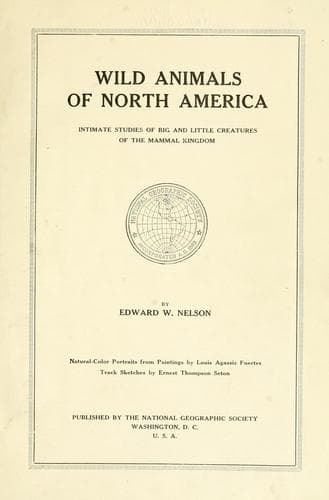
Wild Animals of North America: Intimate Studies of Big and Little Creatures of the Mammal KingdomNelson, Edward William
Science
Wild Animals of North America: Intimate Studies of Big and Little Creatures of the Mammal Kingdom
Nelson, Edward William
Mammals -- North America
Scent glands are common among rodents, carnivores, and insectivores,
but are ordinarily used for purposes of communication with others of
their kind, sometimes to attract the opposite sex and sometimes merely
to give notice of their presence in a locality.
The hard school of experience holding through the ages has taught many
of our rodents the necessity of lying up stores of food to meet periods
of scarcity. Many species store food in a desultory way whenever a
surplus is available, but when harvest time comes, at the close of
summer, the work is taken up as a serious occupation during many busy
hours each day or night by the species living where the severe northern
winters make the stores a necessity.
The storage instinct is possessed as well by many of the southern
desert species, where climatic conditions permit activity throughout
the year. In such regions the supplies serve during storms and in
periods of drought, when the yield of plant food is limited.
[Illustration:
Photograph by Howard Taylor Middleton.
ARMED NEUTRALITY: A DOG AND A SKUNK PREPARE FOR COMBAT
Once in a lifetime the photographer of wild life gets an opportunity
such as is recorded here. Luck was with the camera man, but not with
the terrier, as a moment after this picture was made the dog was a very
nauseated and embarrassed animal, the skunk having employed its natural
weapon with overpowering odoriferous effect.]
GOOD HOUSEKEEPING IN RODENT LAND
One can but marvel at the wise prescience with which northern rodents
gather their winter stores and hide them away safe from the weather
in secret places in hollow trees, old logs, crevices among the rocks,
or in neat storage chambers dug for the purpose adjoining underground
burrows. The size of the stores and the tireless industry of these
little husbandmen in gathering them might well serve as examples worthy
of emulation by some of their human neighbors. The seeds gathered are
freed from chaff, the grasses and herbs are dried as “hay,” and roots
are carefully cleaned before being stored.
The storing habit appears to be nearly always for purely individual
benefit. The food is usually stored in bulk, but squirrels and
chipmunks often bury here and there single nuts, which they are able to
recover long afterward through their extraordinary powers of smell.
Stores are laid by for a single season, and a single failure of a nut
or seed crop will cause the starvation of many small animals, and the
failure of the crops for two or more seasons is so disastrous that the
rodents may nearly or quite all die of famine over great areas. The
reverse of this occurs during successive years of bountiful nut and
seed crops.
An abundant food supply appears to be a powerful stimulant to the
fecundity of mammals, and the number of young at a birth, as well as
the number of litters born during a season, are greatly increased by
it, until their haunts fairly swarm with them.
THE EBB AND FLOW OF ANTAGONISTIC SPECIES
Public-domain text, read in full here on John Shaqi.
Reviews
Reviews
No reviews yet
Be the first to share your thoughts on this work.
Elsewhere in the archive
Join the Discussion
Join the discussion
Sign in to leave a comment or review.
Sign InorCreate an account