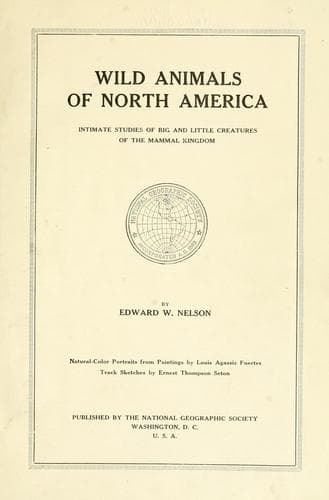
Wild Animals of North America: Intimate Studies of Big and Little Creatures of the Mammal KingdomNelson, Edward William
Science
Wild Animals of North America: Intimate Studies of Big and Little Creatures of the Mammal Kingdom
Nelson, Edward William
Mammals -- North America
In contrast to the protective coloration are certain markings, like the
cottony white underside of the tail of the cottontail rabbit, which
renders the flight of this animal conspicuous in the gloomiest shades
of the forest, or even on the approach of night, when it is impossible
to distinguish the animal itself. The white underside of the tail of
the antelope chipmunk is another well-defined instance of this kind.
NEW COATS FOR BOREAS’ COURT
The most marked of all examples of “directive” coloration among the
small mammals appears to be that of certain white-sided jack-rabbits,
in which the white areas on the sides and rump are drawn up and down
as the animal runs across the plains, giving a flashing effect, which
attracts attention to them exactly as does the white rump-patch of the
antelope.
In the northern part of the continent, where snow lies for many months,
several species of hares are dusky or buffy gray in summer and change
to a pure white coat in winter. This change is of enormous protective
value to these animals. In Greenland, where the summer is short and
snow exists throughout the year, the highest northern representative
of the hares remains permanently white, while near the southern border
of snow in the United States the varying hares and white-tailed
jack-rabbits, which become pure white in the northern parts of their
range, make only a partial change.
Weasels are the only carnivores which change from the brown of summer
to a white winter coat. Owing to their small size and the need for
activity in the snowy northern regions, where they would be peculiarly
susceptible to danger from birds of prey and larger predatory animals,
their protective white coats serve them well.
It was formerly considered that the change of mammals from the brown of
summer to the white winter coat in the fall, and from the white to the
brown in spring, was due to a change in the color of the hairs, but it
is now known that it is entirely due to molt. The time of these changes
depends on the season, and this varies several weeks, according to
whether the fall or spring is early or late.
The general shades of mammals are of delicate tints, and the spots,
stripes, and other markings, as in the case of chipmunks and the little
spotted skunk, are often of great beauty.
ANIMALS THAT HAVE TO SING
Small mammals vary greatly in their vocal powers, but the changes in
intonation and character of the notes and calls indicate plainly that
they are used to convey a variety of meanings.
Some are practically voiceless, as in the case of rabbits and hares,
except when in an extremity of fear they utter loud shrieks of terror.
Squirrels, prairie-dogs, and some other small mammals bark and chatter,
while mice and bats have a variety of curious squeaking notes. Marmots
and ground-squirrels have chattering notes and sharp, whistling calls.
Public-domain text, read in full here on John Shaqi.
Reviews
Reviews
No reviews yet
Be the first to share your thoughts on this work.
Elsewhere in the archive
Join the Discussion
Join the discussion
Sign in to leave a comment or review.
Sign InorCreate an account