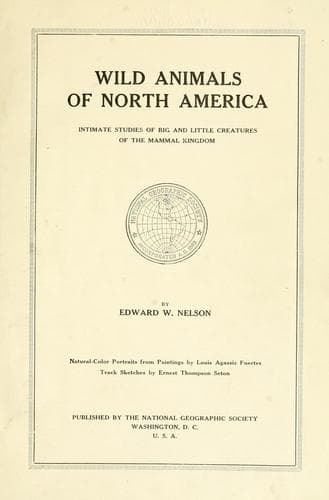
Wild Animals of North America: Intimate Studies of Big and Little Creatures of the Mammal KingdomNelson, Edward William
Science
Wild Animals of North America: Intimate Studies of Big and Little Creatures of the Mammal Kingdom
Nelson, Edward William
Mammals -- North America
In the northern parts of the Old and New Worlds many mammals, including
bears, marmots, prairie-dogs, ground-squirrels, and jumping mice,
pass a large part of the winter months in a lethargic sleep called
hibernation. While hibernating these animals have extremely slow and
slight heart action and their bodily temperature falls far below the
normal of their active periods. During the most profound hibernation
an animal may be awakened if brought into a warm temperature, but when
again put into the cold at once returns to sleep.
Preparatory to this sleep, during the summer and in the autumn, the
hibernating mammals become exceedingly fat.
It has long been generally accepted that the fat thus accumulated was
for the purpose of being gradually absorbed to nourish the animals
during their long fast. As a matter of fact, during this period the
bodily functions appear to be practically suspended and the animals
may be said to be in cold storage. This is evident from the fact that
observations have been made of ground-squirrels, and even bears,
emerging in spring, after their long winter sleep, practically as fat
as when they retired in fall. Hibernating animals become extremely
active as soon as they come out in spring and quickly lose the fat
which should be of special service to them, owing to the temporary
shortage of food they experience at this season.
Most hibernating species do not retire for the winter until cold
weather is at hand, in September or October, at times remaining out
until after the first snow has fallen. The animals which retire
latest, like chipmunks and prairie-dogs, sometimes appear temporarily
during certain warm periods in winter.
Recent observations have established the fact that the adults of both
sexes of the Richardson ground-squirrel living in the Northwestern
States and adjacent parts of Canada become excessively fat by the first
of July, and before the first of August practically disappear for the
season, not appearing again until they emerge the following March or
April. The retirement of these squirrels for a part of the summer is
a case of imperfect estivation, as it is termed, followed by complete
hibernation. The young of the year enter hibernation at a considerably
later date.
DEFENSIVE AND OFFENSIVE ANIMAL ALLIANCES
A great number of both large and small mammals live solitary lives
except for brief periods during the mating season or the association
of the young with the mother. Some species, however, like the wolves
and coyotes, may mate permanently and show great mutual affection and
constancy. Many species have well-developed social instincts, which
appear in some cases to combine two purposes, self-defense and the
desire for companionship.
Public-domain text, read in full here on John Shaqi.
Reviews
Reviews
No reviews yet
Be the first to share your thoughts on this work.
Elsewhere in the archive
Join the Discussion
Join the discussion
Sign in to leave a comment or review.
Sign InorCreate an account