Historical fiction; United States -- History -- Colonial period, ca. 1600-1775 -- Fiction
Produced by Bruce Albrecht, Mary Meehan and the Online
Distributed Proofreading Team at http://www.pgdp.net
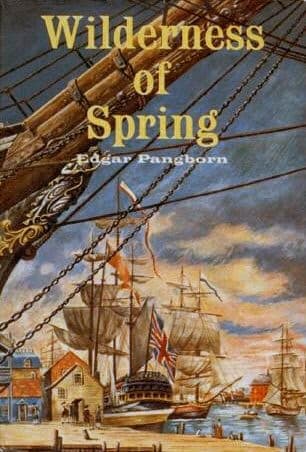
_Wilderness of Spring_
By EDGAR PANGBORN
... For if I am in sore plight, I would not therefore wish
affliction to be the lot of all the world. No, indeed, no! since,
besides, I am distressed by the fate of my brother Atlas, who,
towards the west, stands bearing on his shoulders the pillar of
heaven and earth, a burthen not easy for his arms to grasp.
--AESCHYLUS, _Prometheus Bound_.
_Rinehart & Company, Inc._
NEW YORK TORONTO
_Published simultaneously in Canada by
Clarke, Irwin & Company, Ltd., Toronto_
Copyright _1958 by Edgar Pangborn
Printed in the United States of America
All Rights Reserved
Library of Congress Catalog Card Number: 58-5139_
_To my Sister_,
MARY C. PANGBORN
NOTE: Pastor John Williams of Deerfield is a historical figure; Belding,
Stebbins, Hoyt, Wells and Hawks were actual names in the Deerfield of
1704. With these minor exceptions, all characters in this novel are
completely fictitious, not intended to suggest any actual person living
or dead.
The language of the dialogue is a compromise, an attempt to convey some
quality of early eighteenth-century speech, but not to create a literal
reproduction of it, since that might be tedious and obscure in some
places to modern readers. For a literal reproduction the worst nuisance
would have been those words, such as "naughty," that have changed not in
form but in meaning or emotional charge. I have tried to avoid all these
except where the context should make plain their archaic sense. I think
the use of "thee" and "thou" is substantially correct. At that time the
second person singular could be used in English as in most European
languages today, for intimates and children, but the universal "you" was
already displacing it. The third person singular verb ending was
obsolescent but still in some use; "hath" and "doth" seem to have
survived long after the ending was abandoned in other verbs.
In the modern (_Everyman_) edition of Montaigne, the essay that Mr.
Kenny asks for is entitled "Of Training" instead of "Use Makes Perfect."
The copy from Mr. Kenny's library was the seventeenth-century
translation by Charles Cotton.
My special thanks to Mrs. Kelsey Flower of Deerfield, who gave me
welcome aid with the research; and to the personnel of the State Library
at Albany, N.Y. for their unfailing helpfulness and courtesy.
E.P.
PART ONE
_Chapter One_
Public-domain text, read in full here on John Shaqi.
Reviews
Reviews
No reviews yet
Be the first to share your thoughts on this work.
Join the Discussion
Join the discussion
Sign in to leave a comment or review.
Sign InorCreate an account