Etext prepared by Dagny, dagnyj@hotmail.com
Emma Dudding, emma_302@hotmail.com
and John Bickers, jbickers@ihug.co.nz
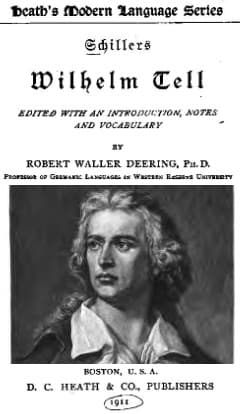
Wilhelm Tell
by Johann Christoph Friedrich von Schiller
Translator: Theodore Martin
INTRODUCTORY NOTE
Johann Christoph Friedrich von Schiller was born at Marbach,
Wurtemberg, Germany, November 10, 1759. His father had served both as
surgeon and soldier in the War of the Austrian Succession, and at the
time of the poet's birth held an appointment under the Duke of
Wurtemberg. Friedrich's education was begun with a view to holy
orders, but this idea was given up when he was placed in a military
academy established by the Duke. He tried the study of law and then of
medicine, but his tastes were literary; and, while holding a position
as regimental surgeon, he wrote his revolutionary drama, "The
Robbers," which brought down on him the displeasure of his ducal
master. Finding the interference with his personal liberty
intolerable, he finally fled from the Duchy, and in various retreats
went on with his dramatic work. Later he turned to philosophy and
history and through his book on "The Revolt of the Netherlands" he was
appointed professor extraordinarius at Jena, in 1789. His "History of
the Thirty Years' War" appeared in 1790-93, and in 1794 began his
intimate relation with Goethe, beside whom he lived in Weimar from
1799 till his death in 1805. His lyrical poems were produced
throughout his career, but his last period was most prolific both in
these and in dramatic composition, and includes such great works as
his "Wallenstein," "Marie Stuart," "The Maid of Orleans," "The Bride
of Messina," and "William Tell" (1804). His life was a continual
struggle against ill-health and unfavorable circumstances; but he
maintained to the end the spirit of independence and love of liberty
which are the characteristic mark of his writings.
This enthusiasm for freedom is well illustrated in "William Tell," the
most widely popular of his plays. Based upon a world-wide legend which
became localized in Switzerland in the fifteenth century and was
incorporated into the history of the struggle of the Forest Cantons
for deliverance from Austrian domination, it unites with the theme of
liberty that of the beauty of life in primitive natural conditions,
and both in its likenesses and differences illustrates Schiller's
attitude toward the principles of the French Revolution.
WILHELM TELL
by Johann Christoph Friedrich von Schiller
DRAMATIS PERSONAE
HERMANN GESSLER, governor of Schwytz, and Uri.
WERNER, Baron of Attinghausen, free noble of Switzerland.
ULRICH VON RUDENZ, his Nephew.
People of Schwytz:
WERNER STAUFFACHER.
CONRAD HUNN.
HANS AUF DER MAUER.
JORG IM HOFE.
ULRICH DER SCHMIDT.
JOST VON WEILER.
ITEL REDING.
People of Uri:
WALTER FURST.
WILHELM TELL.
ROSSELMANN, the Priest.
PETERMANN, Sacristan.
KUONI, Herdsman.
WERNI, Huntsman.
RUODI, Fisherman.
Public-domain text, read in full here on John Shaqi.
Reviews
Reviews
No reviews yet
Be the first to share your thoughts on this work.
Join the Discussion
Join the discussion
Sign in to leave a comment or review.
Sign InorCreate an account