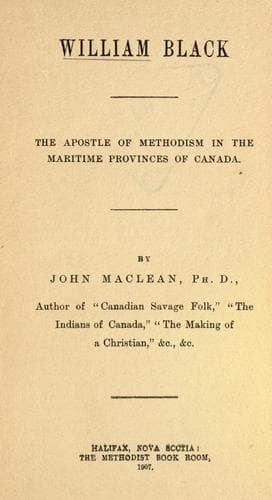
William Black: The Apostle of Methodism in the Maritime Provinces of CanadaMacLean, John
Religion
William Black: The Apostle of Methodism in the Maritime Provinces of Canada
MacLean, John
Black, William, 1760-1834; Wesleyan Methodist Church -- Clergy -- Biography
He travelled on snow-shoes in the winter, and by boat or on horseback
in the summer, and when these failed, he journeyed by log canoe, or
walked over the bad roads. Once he walked forty five miles that he
might spend the Sabbath with the people in Windsor. Sometimes he was
in dangers by the sea, and glad after a hard day's work in the winter
to have a little straw to lie upon, and a thin cover to shelter him
from the cold. Like the early preachers he was often compelled to
suffer opposition, rough fellows disturbing the services by shouting
and seeking to break up the meeting, and some who were possessed of
education demanding his authority for preaching the gospel, but to
them all, he was patient, and some of his revilers were soundly
converted, and learned to revere him as a man of God.
As a preacher he was eminently successful in awakening the people from
a state of spiritual torpor, and winning many souls for Christ. In
nearly every service there were conversions, and deep manifestations
of the presence and power of God. When he preached at Memramcook,
"some were deeply affected;" at French village, he left the people in
tears, and the truth had a softening power upon the hearts of the
people; and when he was leaving them, "weeping was upon every hand,"
and they pressed him so hard, that he remained another day, when many
were deeply affected, and he left them in tears. On the same day and
the one following, he was at Hillsborough, when "it was a moving time,
many were in great distress, as appeared from their heaving breasts
and weeping eyes;" at Tantramar, "many were remarkably happy," and one
little girl of seven or eight years of age, "got up on a form, and
told in a wonderful manner, what Jesus had done for her soul," and in
this journey of eight days he preached eighteen times, and excepting
two meetings, he says, "I know not a single occasion in which it was
not evident that many who heard the Word were melted into tears, if
they did not cry aloud for mercy."
All through his journal, there are evidences that he was a preacher of
great power, eminent in the conversion of the people, for the pages
abound with references to the services as "a time of power," where
"many were in sore distress" as they hung around him, "eager to catch
every word," and "weeping was on every hand," as they besought him to
remain longer with them. When preaching one evening a young man
trembled exceedingly, and cried out in agony of soul, and about
bed-time, the preacher heard him praying and crying in the barn. On
one of his missionary tours there were so great manifestations of
power, that at Horton many cried for mercy, and others rejoiced and
shouted aloud; at Cornwallis the arrows of conviction were felt by
some "as they had never felt them before, and wept aloud most of the
time;" and at Falmouth, "many felt the power of the word," and
rejoiced exceedingly.
Public-domain text, read in full here on John Shaqi.
Reviews
Reviews
No reviews yet
Be the first to share your thoughts on this work.
Join the Discussion
Join the discussion
Sign in to leave a comment or review.
Sign InorCreate an account