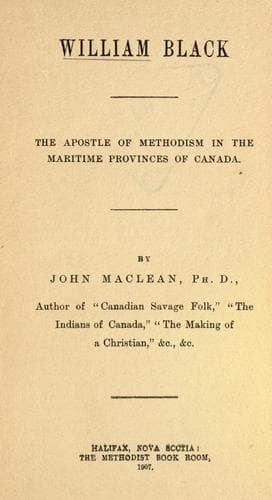
William Black: The Apostle of Methodism in the Maritime Provinces of Canada — John Shaqi
William Black: The Apostle of Methodism in the Maritime Provinces of CanadaMacLean, John
Religion
William Black: The Apostle of Methodism in the Maritime Provinces of Canada
MacLean, John
Black, William, 1760-1834; Wesleyan Methodist Church -- Clergy -- Biography
Had Longfellow the poet extended his studies a few years later than
the time of the event which formed the subject of Evangeline, he would
have come in contact with another race of men, of different breed,
language and faith, than that of the Acadians, who were as brave as
any of those who sailed away from the valley of the Gaspereaux. For
almost coincident with the expulsion of these hardy folk from the
fertile fields of the Annapolis Valley, there came visitors from the
New England colonies, induced by offers of land, but these were
deterred from settlement on account of a fear lest freedom of
religious worship should not be accorded them.
Brought up under the influence of the descendants of the Pilgrim
Fathers, they prized too highly their religious liberty to barter it
for lands or gold, and not until a second proclamation was issued,
granting liberty of conscience and worship to all Protestants, did
settlers come in large numbers. Five years after the Acadians were
expelled emigrants began to arrive in considerable numbers from New
England and from Great Britain and Ireland. This was the beginning of
a new era, in which the principles of the Protestant Reformation were
to be tested, upon soil consecrated by the faith and piety of the
Roman Catholic exiles, and an opportunity was found for the expression
of the new faith in the moulding of individual character.
While the province was issuing invitations for new settlers and
wishing to grant concessions to sturdy and loyal folks, a great
awakening was taking place in England, the influence of which was
destined to become a strong factor in making a new race on the Western
Continent, and to mould in a great measure the social and religious
life of the people of Nova Scotia. A revival of spiritual life was in
progress under the preaching of Wesley and Whitefield, which was
quickening the consciences of the people, imparting high ideals and
renovating the social and political life of the nation.
Methodism was doing greater things for the English speaking race than
Luther among the Germans, as it infused a spirit of joy and freedom
from ritual, with greater liberty of thought and action. It was an era
of great names beyond the pale of the national church. The passion for
souls became so intense in the hearts of many of the clergy that they
gladly espoused the hated name of "Methodist," while others no less
zealous stood aloof from the special movement because of its Arminian
doctrines.
Public-domain text, read in full here on John Shaqi.
Reviews
Reviews
No reviews yet
Be the first to share your thoughts on this work.
Join the Discussion
Join the discussion
Sign in to leave a comment or review.
Sign InorCreate an account