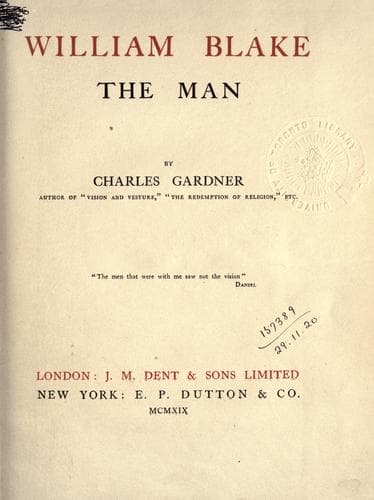
Blake's father was a hosier. His name was James, he was married to
Catherine, and they had five children, William being the second. James was
a dissenter, but, like so many dissenters, he liked such important
functions as baptism, marriage, and burial to be performed by the Church
of England, that there might be no mistake about them. Accordingly,
William was taken on December 11th, when he was a fortnight old, to be
christened at St James's Church in a Grinling Gibbons font, the highly
ornate character of which was fortunately not observed by the tender
recipient of baptismal grace.
William was a solitary, imaginative boy. His imagination was first
stimulated and nourished by town. His father's home, in sharp contrast
with the older houses in the neighbourhood, made him perceive that there
was a meaning Past as well as a so-far unmeaning Present: and the moment
his imagination escaped into the past it tended to abstraction, but knew
no bounds.
Very soon in his solitary walks he found his way into the country,
emerging from London on the south side and exploring as far as Peckham
Rye, Dulwich, Streatham, and Sydenham. His first glimpse of the country
was to him as our first trip abroad to us. The trees, the hills, the grass
and the cattle spoke obliquely to an imagination that already had a bias.
He loved them--with discretion. To him London was older than the country.
Nature has a way of disguising her great age in an ever renewed youthful
present. London's present drives one to the past. Nature bewitches her
children and will not allow them to transcend her. A great city with its
pulsing life carries the exuberant spirit in its mighty rhythm, and yet
drives it back to the ancient primeval sources concealed in the eternal
kingdom of the imagination. Wordsworth, Nature's lover, soothes and lulls
our restlessness and pain, but fails to carry us into the promised land.
Blake, the inspired citizen, pierces with his sword through Nature, and
will not rest until in England's green and pleasant land he has built
Jerusalem, wherein we may feast as comrades and be satisfied with the wine
of eternity.
Public-domain text, read in full here on John Shaqi.
Reviews
Reviews
No reviews yet
Be the first to share your thoughts on this work.
Join the Discussion
Join the discussion
Sign in to leave a comment or review.
Sign InorCreate an account