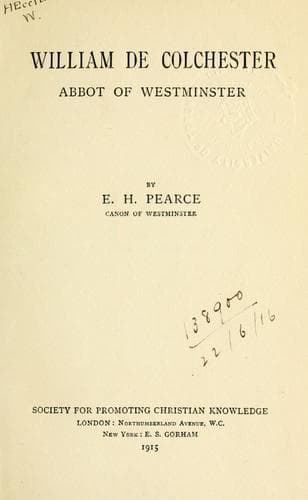
William de Colchester, Abbot of WestminsterPearce, Ernest Harold
History
William de Colchester, Abbot of Westminster
Pearce, Ernest Harold
William, of Colchester, Abbot of Westminster, approximately 1338-1420
He left Westminster on June[22] 10, 1377, and was absent, as he is careful
to record, for two years, twenty-three weeks, and three days. His first
business was to furnish himself with official commendations, and to
this end he sought for royal letters--pro expedicione cause--from the
Keeper of the Privy Seal; he paid 3_s._ 4_d._ to the Keeper's servant to
urge his master to dictate them, and by a like payment he made things
right with the scrivener who would execute them; but the letters were
not ready when he started. Meantime we can watch him as he reckons up
the difficulties of his ordeal. It was arranged that he should go by
way of Avignon, for Master Thomas Southam,[23] Archdeacon of Oxford,
was still there, settling the affairs of Cardinal Langham's will. But
the Pope was no longer there. Gregory XI. had quitted that scene of
luxurious exile and ravenous extortion on September 13, 1376, and had
entered Rome on January 17, 1377.[24] Most Englishmen had resented
the Avignonese sojourn because it threw the Papacy into the hands of
the French, but William Colchester, as he packed his valise, saw the
matter in a different light. Because the Pope had left, there was
no great chance of finding company for the journey;[25] and company
meant so much the more security. There was nothing for it but to hire
a companion, and he found one Gerard of London, who was willing to face
the journey for 20_s._ and his expenses. Colchester is conscious that
this seems an extravagance, but he enters in his account a plea that it
was justified by the variety of language and the dangers of the roads in
foreign parts.[26] For the road to Dover he bought for himself a horse and
saddle which cost 34_s._ 8_d._; but it appears that he rather expected
the man Gerard to walk, for he extenuates a further payment of 26_s._
8_d._ for a horse, a saddle, and bridle for Gerard, by stating that
the man entirely declined to go afoot. Thus mounted, they reached Dover,
where they wasted five days in waiting for a passage, and all the time
the cost of food was mounting up at the rate of sixpence a day for each
horse, and fivepence a meal for each man. The passage, when they obtained
one, cost 3_s._ 4_d._ each for the men, and double for the horses. At
that cost they reached Calais, and within three days were at Bruges,
where again there was a long halt. For the royal letters had not come.
Edward III. was on his death-bed, and passed away eleven days after
our travellers left London. But Colchester is convinced that an enemy
had done this, and when he insists that the issue of the letters has
been frustrated "per aduersarios," we must remember that the Dean and
College of St. Stephen's were closer to the royal ear than our Abbot and
Convent. Whatever the cause, the result was the entry in his account of
the cost of nine days' commissariat at Bruges, together with a reward
of 10_d._ to the hotel servants, which he at once resents and excuses
Public-domain text, read in full here on John Shaqi.
Reviews
Reviews
No reviews yet
Be the first to share your thoughts on this work.
Join the Discussion
Join the discussion
Sign in to leave a comment or review.
Sign InorCreate an account