William de Colchester, Abbot of Westminster — John Shaqi
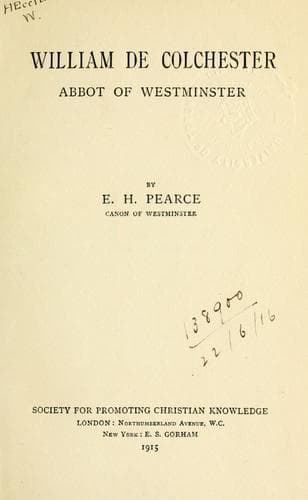
William de Colchester, Abbot of WestminsterPearce, Ernest Harold
History
William de Colchester, Abbot of Westminster
Pearce, Ernest Harold
William, of Colchester, Abbot of Westminster, approximately 1338-1420
We turn back to Colchester's own ledger, and note that he does not enter
the actual date of his arrival in Rome; but we can fix it fairly closely.
He says that, having got thus far, he was obliged to move on to Anagni,
some forty miles southward from Rome on the road to Naples; and we know
that Gregory XI., who had spent the summer of 1377 there, returned to
Rome on November 17.[31] Colchester must have found the Papal Court busy
at the packing of its trunks and must have returned with it forthwith
to Rome; for the first date that he mentions is November 20. It would
be wearisome to pursue the details of his activity in engaging counsel,
English and Italian, and in paying their fees; but it is worth while
to notice that there has been no great change since his day in legal
expressions--retinuit duos aduocatos--and perhaps not a complete reform
of illegal practice; for instance, he explains that he gave six florins
to the valet--cubicularius--of the Cardinal of Milan, who was concerned in
the decision of the case, with a view to the man's stirring up his master
to sign a certain document; the object of the gift, says Colchester,
was greater security, because at the moment there was a fierce altercation
between the parties to the suit.
His expenses, already large, received a sudden addition through the death,
on March 27, 1378, of Gregory XI. Seldom can an observant traveller have
had a more exciting experience than to be in Rome during the session of
the Consistory[32] which set Bartolommeo Prignano, Archbishop of Bari,
upon what Colchester calls "the apex of the chief Apostolate." On personal
grounds our monk must have been pleased at the choice of the electors,
for the new Pope was the special _protégé_ of the French Cardinal of
Pampeluna, Simon Langham's friend and executor. But financially the
effect was provoking. We know that Urban VI. proved himself a man "full
of Neapolitan fire and savagery," who thought "that the Cardinals could
be reduced to absolute obedience by mere rudeness,"[33] and we are quite
prepared for Colchester's statement that between the Pope and the Sacred
College there arose a great dissension. Cardinals and curials fled
secretly, he says, in some numbers, and among the latter the two advocates
whom he had briefed and paid. That money at any rate was a dead loss, but
there was this advantage in Urban's case, that, knowing the preference of
the Cardinals for Anagni as a summer residence, he decided for Tivoli in
their despite, and Colchester could get there in a few hours for a couple
of florins. Six weeks had to be spent within sound of Horace's waterfall
before his business was finished. His return journey led him through Nice,
where he was robbed of his cloak and other property. Then to Avignon
once more, and thence in due course--at least, so he hoped--to the Abbey.
Public-domain text, read in full here on John Shaqi.
Reviews
Reviews
No reviews yet
Be the first to share your thoughts on this work.
Join the Discussion
Join the discussion
Sign in to leave a comment or review.
Sign InorCreate an account