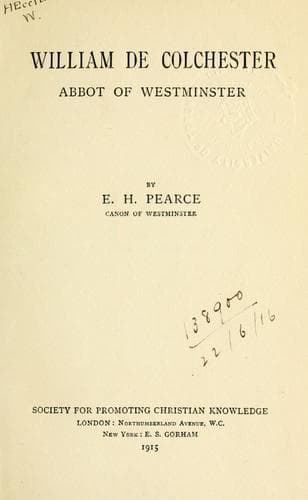
William de Colchester, Abbot of WestminsterPearce, Ernest Harold
History
William de Colchester, Abbot of Westminster
Pearce, Ernest Harold
William, of Colchester, Abbot of Westminster, approximately 1338-1420
As a second proof of the confidence reposed in him we may note that in
1382[38] he was Archdeacon of the Convent; it is possible that he held
the post earlier; certainly he held it in 1386; and probably he owed it to
the Abbot personally. The office of Archdeacon is proverbially puzzling
to the lay mind, and it may be that the Archdeaconry of Westminster
creates some wonder in the minds even of other Archdeacons. The fact is
that the Abbot in the exercise of jurisdiction over his Westminster area
required the services of an ecclesiastical jurist in matters of divorce
and of excommunication and the like; he needed also some one who would
serve as his pastoral representative to those denizens of the area who
were not on the foundation of the Convent. For this reason, even in
Abbot Ware's time,[39] the Archdeacon was permitted to walk abroad
to the Palace or elsewhere in the discharge of his duties, which,
indeed, might take him much further afield; for when Abbot Colchester
drew up an indenture[40] appropriating to certain memorial purposes the
revenues of Aldenham church, he inserted a provision that the Archdeacon
of Westminster for the time being should be in charge of the parish,
receiving 40_s._ yearly for his labour therein. We have seen that
Colchester's experience marked him out for juridical duties, and we
must assume that he was not without pastoral zeal and aptitude.
A letter in Norman French addressed by "William, Conte de Salisbury"
to Abbot Litlington will help us to see that his duties were of a
varied character. The writer of the letter[41] was William de Montacute,
2nd Earl, who fought at Poitiers and in most of the French wars of his
time. Addressing the Abbot as his dear and faithful friend, he thus
unfolds his story. His servant, Nicholas Symcok, of London, has been
robbed in the middle of June by highwaymen, one of whom, Richard Surrey,
is popularly known as Richard atte Belle. The knight of the road has made
off with some silver plate and £40 in coin, and has taken sanctuary at
Westminster, being hotly pursued by his victim, who finds on Surrey's
person all his lost property, less £5 of the stolen money. Symcok has
deposited his recovered goods in the hands of Dan William Colchester,
one of the lord Abbot's monks, who has laid them aside and placed his
seal upon the package. Therefore, my good Lord--asks the Earl--I pray
you have these chattels delivered up to my servant. This letter bears no
date, and there is no proof that the Archdeacon as such was concerned
with the affairs of sanctuary; nor does any title of office accompany
the introduction of his name. But the incident was one which bore a
legal character and Colchester's part in it may possibly be brought
within the vague limits of archidiaconal functions.[42]
Public-domain text, read in full here on John Shaqi.
Reviews
Reviews
No reviews yet
Be the first to share your thoughts on this work.
Join the Discussion
Join the discussion
Sign in to leave a comment or review.
Sign InorCreate an account