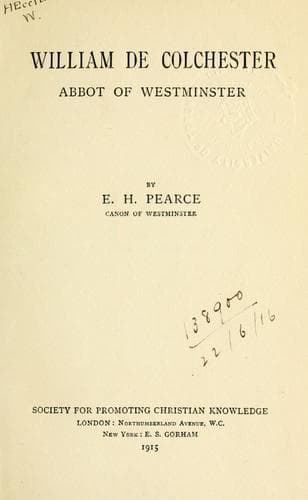
William de Colchester, Abbot of WestminsterPearce, Ernest Harold
History
William de Colchester, Abbot of Westminster
Pearce, Ernest Harold
William, of Colchester, Abbot of Westminster, approximately 1338-1420
There is less doubt about the position of the chambers, which are
often mentioned in connexion with the Infirmary, and which were
probably attached to Little Cloisters, then recently rebuilt by Abbot
Litlington. To this day the south side of Little Cloisters shows
an alternation of old doors and old windows that suggests a row of
almshouses. It thus becomes easy to realize that a separate residence,
instead of the usual bed in the Great Dormitory, was a privilege highly
prized and rarely conferred.
[Illustration: CHAMBERS IN LITTLE CLOISTERS.]
It is natural to ask in what conditions the tenants of these chambers
lived, and the answer can be given in some detail. We have a long
strip of frail paper,[47] 3 ft. 7 in. × 5-1/2 in., which deals with the
post-mortem distribution of the effects of a monk whom William Colchester
must have known long and well. Richard Excestr' said his first Mass,
as did Colchester himself, in 1361-2; he became Prior quite early in
life, in 1377; but, as we have seen, he resigned the office in 1382,
and we do not know why his tenure of it was so brief. That the reason was
not discreditable to himself may be inferred from the fact that on his
resignation he was given precedence next after the new Prior, receiving
a pension of four marks, a double, or Prior's, assignment of clothing,
and a double share of the pittances that marked certain anniversaries,
till his death in 1397. In this paper, then, his modest effects are
arranged according to the rooms in which they stood, like the items in
an auctioneer's catalogue when the sale is to take place, by order of
the executors, on the premises. We gather that he has a reception-room,
or "aula," where he can entertain a few friends, with a special welcome
for any Brother who can play chess (for among his possessions are a
chess-board and a set of chess-men[48]); a pantry, or "buteleria,"
for his little store of plate and crockery and napery, including
a silver cup and cover, thirteen silver spoons (was it a complete
"Apostle" set?), and a table-cloth 3-1/2 yards in length; a bedroom, or
"camera," containing his white bedstead with a tester over it, and a
"parpoynt," as well as his wardrobe; a kitchen, or "coquina," equipped
with "droppyngpannes," "dressyng-Knyues," "flesshhokys," "anndyrons,"
a "treuet," and three pans which like the trivet are honestly described
in the catalogue as being the worse for wear;[49] and a library, or
"studium," with ten books and three maps. Among these books there was of
course some scholastic theology and canon law, but there was also the
Latin version of the Book of Messer Marco Polo, as if to signify that the
latest modern literature was by no means excluded. The Provost of King's,
who was kind enough to look through the list for me, takes this to be,
as I suspected,[50] a very early instance of English interest in the
Venetian traveller's adventures; and added that he believes it to be
Public-domain text, read in full here on John Shaqi.
Reviews
Reviews
No reviews yet
Be the first to share your thoughts on this work.
Join the Discussion
Join the discussion
Sign in to leave a comment or review.
Sign InorCreate an account