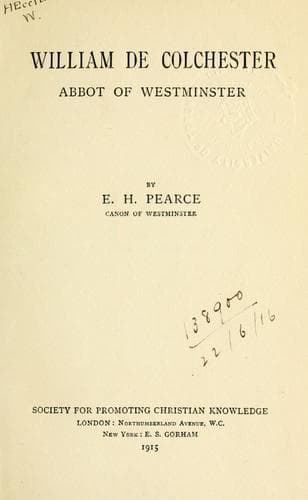
William de Colchester, Abbot of Westminster — John Shaqi
William de Colchester, Abbot of WestminsterPearce, Ernest Harold
History
William de Colchester, Abbot of Westminster
Pearce, Ernest Harold
William, of Colchester, Abbot of Westminster, approximately 1338-1420
A MAN OF AFFAIRS
Soon after his return from the University two things happened, as if to
signify that his competence was recognized. In October, 1371, he was
promoted, as the Westminster phrase went, to sit by the bell--sedere
ad skillam; that is to say, he moved up to the seniors' table in the
Refectory, where was the bell or skyllet which gave the signal for grace
to be said, or for the reader of the week to begin the lection. Like the
day of his first Mass, this promotion, coming as a rule not less than ten
years later, was reckoned to be an occasion for a little addition to the
usually frugal fare, and we can state the date of it because the Sacrist
and the Infirmarer and the Treasurer each sent him bread and wine to the
value of 2_s._ 3-1/2_d._, so that he might make merry with his friends.
Secondly, he begins to be recognized as an experienced person who can
safely be sent upon missions involving prudence and the management of
men. In the same year, 1371-2, a payment of twenty shillings was made
by the Steward of the Abbot's Household for the expenses of William
Colchester and two valets who were sent to Northampton for the meeting of
the General Chapter of the English Benedictines, probably in attendance
on the Abbot of Westminster, who was frequently one of the Presidents
of the Chapter.
But the next year, 1372-3, as we learn from the Sacrist, saw Colchester
entrusted with a still more delicate duty. It was on this wise. Among
the precious relics given to the Abbey by Edward the Confessor[12]
was the girdle of the Virgin Mary--zona beate Marie--which she had
made with her own hands and had herself worn.[13] It was regarded as
having especial value in securing a safe delivery to expectant mothers,
and when the Westminster Book of Customs was compiled by Abbot Richard
de Ware about a century before Colchester's admission, it was the rule
that the Sacrist or, as he was sometimes called, the Secretary, should
carry the girdle of the blessed Mother of God to any destination which
it was appointed to reach, or should be at charges with the bearer
of it in his place.[14] So here is our Sacrist paying the expenses of
William Colchester, namely, 13_s._ 4_d._, and the more considerable
price of two horses for the journey, £6 16_s._ 8_d._ But the Sacrist
has something to enter on the other side, an offering of £2 from the
Countess of March, the lady who craved the aid of the girdle. If any
one is churlish enough to say that the bargain seems but a poor one
for the Convent--150_s._ spent on the journey, and only 40_s._ received
from the beneficiary--the answer is that the horses would be sold at the
end of the return journey for almost as much as they cost. If, again,
it is objected that in any case the lady's gift was money thrown away,
it is not so easy to convince the gainsayer. For while it is on record
that on February 12, 1371 (_i.e._ in the year previous to that of the
Sacrist's account), the lady Philippa, granddaughter of Edward III.,
Public-domain text, read in full here on John Shaqi.
Reviews
Reviews
No reviews yet
Be the first to share your thoughts on this work.
Join the Discussion
Join the discussion
Sign in to leave a comment or review.
Sign InorCreate an account