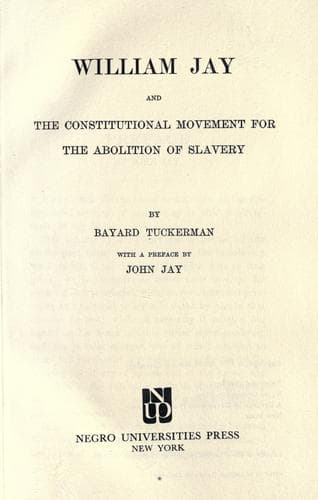
William Jay and the Constitutional Movement for the Abolition of SlaveryTuckerman, Bayard
History
William Jay and the Constitutional Movement for the Abolition of Slavery
Tuckerman, Bayard
Antislavery movements -- United States; Jay, William, 1789-1858; United States -- Politics and government -- 1815-1861
Judge Jay had one brother, Peter Augustus Jay, who was thirteen years
his senior. Between the brothers there continued through life an
uninterrupted affection and confidence. Peter Augustus led an active
professional and social life in New York City, holding office as judge,
as recorder, and as a member of the State Assembly. On his death, in
1843, high tributes to his ability as a jurist and to his character as a
public-spirited citizen were paid by Chancellor Kent, Chief-Justice
Samuel Jones, and David B. Ogden. As a member of the Assembly, he was
conspicuous in the advocacy of various important measures, among which
may be mentioned his efforts to extend the right of suffrage to black
citizens of the State. Peter Augustus Jay was not himself prominent in
the antislavery cause, but he was generally in sympathy with his
brother's work.
The Right Reverend A. Cleveland Coxe, Bishop of Western New York, was a
frequent visitor in his youth at Bedford. Some extracts from a letter
written by him to John Jay afford an interesting view of the domestic
life of the Judge's home:
"William Jay was one of those true sons of the Republic who inherited
sound views of its constitutional system from your illustrious
grandfather, and from personal acquaintance with some other fathers of
the nation who were high in the confidence of Washington and shared his
just and lofty ideas of national policy. Your father was one of those
born statesmen who breathed under the inspiration of such ideas, and was
animated by them to efforts for the preservation of the Constitution
itself in degenerate days. Those were the days when the 'spoils-system'
had begun to act with corrosive effect on public affairs and public men.
The science of true statesmanship seemed ready to perish. The country
fell into the hands of mere politicians, with whom legislation was a
trade and a struggle for personal aggrandizement. The epoch had little
use for men of pure patriotism, but your father, incapable of ambition
or the pursuit of personal ends, stood aside and devoted himself with
intrepidity to unpopular principles, of which he foresaw the utility,
while he was hardly less prophetic of the cruel war which must be the
consequence of popular indifference and blindness to the national
perils. He was little seen, but greatly felt, and has left a mark on the
diplomacy of his time which is a gain to humanity and to civilization.
Public-domain text, read in full here on John Shaqi.
Reviews
Reviews
No reviews yet
Be the first to share your thoughts on this work.
Elsewhere in the archive
Join the Discussion
Join the discussion
Sign in to leave a comment or review.
Sign InorCreate an account