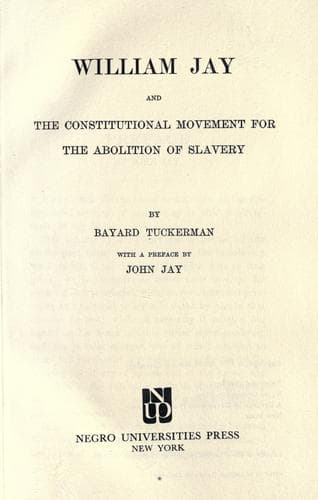
William Jay and the Constitutional Movement for the Abolition of SlaveryTuckerman, Bayard
History
William Jay and the Constitutional Movement for the Abolition of Slavery
Tuckerman, Bayard
Antislavery movements -- United States; Jay, William, 1789-1858; United States -- Politics and government -- 1815-1861
"I cannot forget the charms of that domestic life which he made so
attractive to his children and to the large circle of kindred and
friends who were admitted to its enjoyments. It was in 1836 that, with
our beloved friend Hobart, I was invited to spend the Christmas
holidays at Bedford. We were boys together at that time, and I remember
to what hours we prolonged our recreations, with no other restriction
than your father's cheerful injunction, as he bade us good-night: 'Young
gentlemen, please remember not to laugh too loudly; it might deprive
some of us of the sleep which you seem not to require for yourselves.'
How merrily we 'saw the old year out and the new year in,' that
Christmas-tide! I often thought of Irving's 'Bracebridge Hall' as
realized in America, in the home of your happy boyhood. Year after year,
winter and summer, through college life, you led me to renew my holidays
in Bedford. How much I learned from your father's condescension to
boyhood in conversing with his boy-visitors as if they were men! He drew
out our opinions and encouraged us to state them frankly when he
suspected that we had the boldness to prefer our crude ideas to his own
judicial and grave conceptions of fact and principle. He played chess
with his youthful guests, but never permitted them to beat him, as that
would have been no compliment to lads who worked hard and wished to win
in a fair game.
"I have rarely seen a household in which family life was ordered more
particularly with reference to religion. There was much of the Huguenot
in the piety of the Judge, but nothing of the Puritan. Family prayers
were observed twice a day, the servants attending and sharing in the
responses. After-evening prayers in those early days, we enjoyed a few
cotillons and contra-dances, Mrs. Jay presiding at the piano. And when
the ladies had withdrawn, chess-playing and other games occupied us, not
infrequently until after midnight. Sundays in the old homestead, after
church-going, were like other days, save in the chastened cheerfulness
of conversation and employment. A feature of Sunday evenings was the
custom for every member of the family to recite something in prose or
poetry, and the Judge often closed such recitals by reading selections
from Bishop Heber, Mr. Milman, and other favourites of those times. In
the third decade of this century, the daughters of 'the governor,' Mrs.
Banyer and Miss Jay, were often the guests of their brother. They would
have been interesting figures in any society, and were eminent in New
York for their Christian virtues and devotion to every good work. The
elder sister, born in Spain, seemed to preserve in her face and carriage
something borrowed from her native climate, while Mrs. Banyer, born in
France, was not less conspicuously marked by characteristics of her
French ancestry. While the only son of Judge Jay is a recognized type of
his father's principles and character, his daughters not less resembled
Public-domain text, read in full here on John Shaqi.
Reviews
Reviews
No reviews yet
Be the first to share your thoughts on this work.
Elsewhere in the archive
Join the Discussion
Join the discussion
Sign in to leave a comment or review.
Sign InorCreate an account