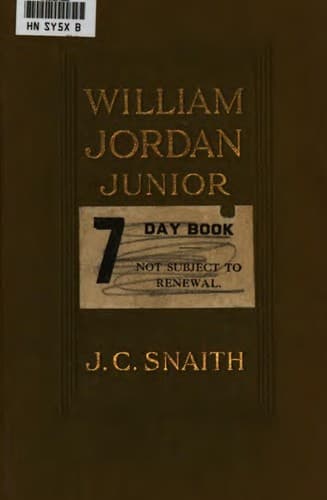
Booksellers and bookselling -- Fiction; Fathers and sons -- Fiction; London (England) -- Fiction; Poets -- Fiction
“Well now, my son, I could see I was pressing with both feet on the
loud pedal. ‘Mr. Dodson,’ said the old mug, ‘I would pay a thousand
pounds to a charitable institution if I could really persuade myself
that I did not leave that wretched money upon my table.’ Well, after
that, Luney, I went in to win. Since I buttered him up over his
Homer--the d---- silliest production, I understand, that ever was
perpetrated--he has always listened to me with what he calls ‘respect.’
He considers me ‘a scholar and a gentleman’; he likes to consider
everybody in this old-established house, from Pa to the ex-caretaker’s
widow, who feeds the cat, to be ‘a scholar and a gentleman.’ Well, I
went for the gloves; I gave him five minutes of regular John Bright,
and wound up with a bit of dissertation on self-deception. And, would
you believe it, Luney? the silly old cormorant wrung me warmly by the
hand, and said if only for his own peace of mind he must admit that he
had deceived himself. The money could not possibly have been there; he
must have left it in his hansom; it must have fallen from his pocket
in Saint James’s Square; in fact, there must be a hideous mistake
somewhere; on no account must I mention it in the office. I must treat
all the circumstances exactly as though they had never occurred.
“Now, what do you say to that, my son? Of course it was all pretty
useful work on the part of J. D. You see I guessed from the first that
like all these ultra-pious church-and-chapel coves he was forcing
himself to swallow that which he knew he had no right to swallow; and
in the end he was able to convince himself it was ‘the right thing’ to
swallow it rather than to admit the cold-drawn truth.”
To the surprise of the triumphant Mr. Dodson, this description of the
further miracle that had been wrought in his favour brought no kind of
relief to the unhappy William Jordan.
“T-there is still my shame,” he muttered.
“You just put that out of your mind, my son,” said the philosopher.
“Throw the money down a drain, and pretend, like Octavius, that the
whole thing never occurred. Of course, if Octavius or any other of
the ultra-pious sect were to overhear me, they would swear I was as
guilty as you are. And so I am; I expect I am far the worse of the
two. Because I don’t call you guilty. You are odd, weak, you have a
tile or two loose, but I could never look on a chap like you as having
deliberate guile. And I mean to stand by you, although I don’t know why
I should. I have nothing to gain; in fact I have everything to lose by
taking up with a chap like you. I don’t recognize J. D., who intends
to get on in the world, no matter what it costs him, in my dealings
with you. But there they are. As I say, my son, you are against my
principles altogether; but the fact remains, Luney, that since I have
come to take up with you, I don’t seem, somehow, as though I can let
you go.”
Public-domain text, read in full here on John Shaqi.
Reviews
Reviews
No reviews yet
Be the first to share your thoughts on this work.
Elsewhere in the archive
Join the Discussion
Join the discussion
Sign in to leave a comment or review.
Sign InorCreate an account