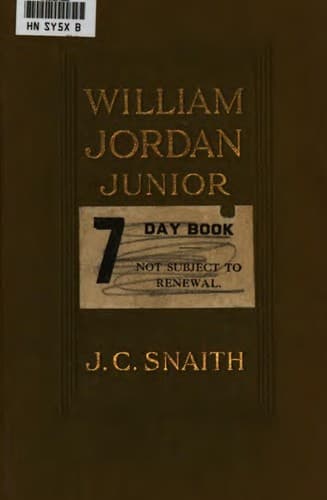
Booksellers and bookselling -- Fiction; Fathers and sons -- Fiction; London (England) -- Fiction; Poets -- Fiction
Scarcely had this fragile figure emerged from the portals of the gaol,
than the wizened and undersized young man, who had been pacing the
flags of the pavement for some little time past, turned and beheld it.
At once he made towards him. Quite suddenly, however, he stopped, as
if in the throes of a profound bewilderment. An expression of pain and
confusion overspread his face.
In the next moment, however, he had gone forward again. It was as
though an irresistible impulse had driven him.
“Why--why,” he said, peering into the great and luminous eyes of the
man who had issued from the portals of the gaol, “can--can it be Luney?”
He who was addressed in this singular manner replied by taking a hand
of the speaker’s in each of his own, and by saluting him upon the
forehead.
XXXVIII
When he had ensconced William Jordan in the interior of the cab Mr.
James Dodson before entering the vehicle himself turned to the man on
the box.
“Cabby,” he said, “as it is a nice morning you can just throw back the
flaps of your machine and take us for a drive round Brixton.”
The cabman interpreted these instructions by uncovering the roof of the
vehicle, and by driving away from the penitentiary at a regulated pace.
Its two occupants were seated side by side.
“Why, Luney,” said Jimmy Dodson in a voice of bewilderment, “I hardly
knew you.”
“Is it surprising?” said his companion.
“And your voice,” said Jimmy Dodson, “I hardly recognize your voice as
belonging to you either. Something seems to have happened to you.”
“As you say,” said William Jordan softly, “something seems to have
happened to me; but,” he added as he laid his delicate fingers
upon those of his friend, “I can never forget those to whom I owe
everything.”
Dodson already felt a curious susceptibility to the new and strange
manner of his companion.
“But, you know, old boy,” said Jimmy Dodson, whose joy in their meeting
was suddenly tempered by the things that were, “all this must be kept
from my people all the same. You see, my father--well, my father is in
the Force, and--and, well naturally, it would not be professional. And
of course you are done for socially--it is no use my disguising it, is
it, old boy? It is only kindness to tell you. And I should be done for
socially too if any of my set knew that I had taken up with you again.
And I should get sacked from the office--my screw is now three hundred
a year--and of course nobody would be to blame but myself. I suppose my
taking up with you again is all very weak and wrong; yet if I must tell
you the truth, Luney, I have come to feel that I would rather not go on
living if I have to do without you.”
The last few sentences of Jimmy Dodson’s remarkable speech, the whole
of which was uttered in a very rapid, mumbling, somewhat incoherent
fashion, far other than the one he was wont to affect, caused a
poignant expression to flit through the large and bright eyes of
William Jordan.
Public-domain text, read in full here on John Shaqi.
Reviews
Reviews
No reviews yet
Be the first to share your thoughts on this work.
Elsewhere in the archive
Join the Discussion
Join the discussion
Sign in to leave a comment or review.
Sign InorCreate an account