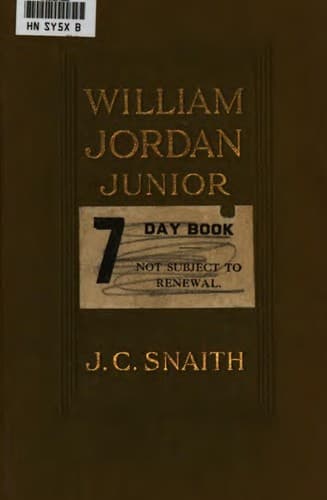
Booksellers and bookselling -- Fiction; Fathers and sons -- Fiction; London (England) -- Fiction; Poets -- Fiction
All stood gaping with amazement and horror, and the boy’s face was
so strange that at first none ventured to come near him. At last the
oldest boy in the school, who was also the boldest, crept round behind
him cautiously, swooped upon him and pinioned his arms. There and then,
with the knife still in his hand, they dragged him into the presence of
the master.
The old man, very infirm and half blind as he was, could not understand
their clamour at first. But when that which had occurred was rendered
clear to him, he ordered every boy to his place. Then addressing the
heavy boy with red hair, he said, “Come to me, Enceladus.”
A deep silence, the fruit of curiosity, was maintained while this boy
lurched up to the master’s table. He wore a smirk of satisfaction upon
his face, as one who, unaccustomed to notoriety, has come to taste it
suddenly.
“Enceladus,” said the aged master, in so sorrowful a voice that it sank
into the hearts even of those who were accustomed to heed it least,
“you are rude and unmannerly. Take up your books and leave us. Never,
upon any pretext, must you come among us again.”
The boy with red hair, insensitive and slow-witted as he was, was as if
stunned by this public and totally unexpected humiliation.
“Why, sir,” he whimpered, “why, sir, it was not I who drew the knife.”
A burning sense of injustice caused the head boy of the school to rise
in his place. He it was who had pinioned the arms of him who had dared
to hold such a weapon.
“No, sir,” he cried, “it was not Enceladus who drew the knife; it was
Achilles.”
“Mnestheus,” said the aged master, addressing the head boy with a stern
melancholy that none had heard on his lips before, “you are declared
unworthy of that office to which you have been called. You also, here
and now, must go from among us, and never, Mnestheus, must you come
among us again.”
Silence and consternation fell upon all as their two companions, thus
excommunicated, passed for ever out of their midst.
From that hour the many wanton acts which had been practised upon
the boy were practised no more. In lieu of the fierce contempt with
which he had been previously regarded, they began to pay him a kind of
respect. This immunity from physical violence, which he enjoyed for the
first time, was even tinged with a kind of homage. It was in nowise due
to his extraordinary preeminence in books, but rather in spite of it,
for it was hard for such unworthy attainment to be condoned. Indeed,
this tolerance was extended to one who had dared to enter upon a course
that had not been possible to the boldest among them.
“Tell us, Achilles,” they demanded in excited tones, “did you intend
_really_ to use the knife?”
“Y-yes,” stammered the boy, as the blood fled from his cheeks; “h-had I
b-been m-made to cry out again, I had buried the knife to the hilt in
his heart.”
Public-domain text, read in full here on John Shaqi.
Reviews
Reviews
No reviews yet
Be the first to share your thoughts on this work.
Join the Discussion
Join the discussion
Sign in to leave a comment or review.
Sign InorCreate an account