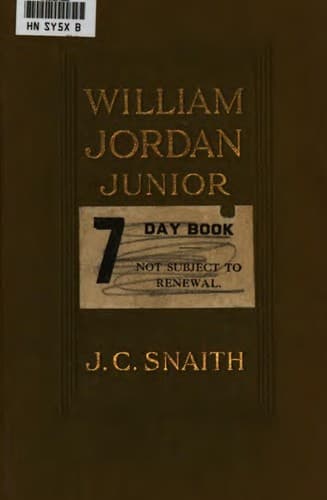
Booksellers and bookselling -- Fiction; Fathers and sons -- Fiction; London (England) -- Fiction; Poets -- Fiction
The countenance of each was remarkable. The eyes of the man were those
which age does not darken; yet his cheeks were gaunt, and the lines
of his frame seemed to be prematurely old; but the ample forehead
and every feature was suffused with the luminosity by which a high
intelligence reflects itself. The face of the boy, pale, gentle and
mobile, was too rare to describe. His eyes, vivid in hue and very
deeply set, were bright with a kind of veiled lustre; his form was
of elfin slightness; his hands looked as frail as gossamer. Yet the
countenance, although full of the solemn wonder of childhood, and
angelic beauty, was marred by a gross physical blemish. Every feature
appeared to have been touched by the wand of a fairy, yet in the middle
of the right cheek was an open wound.
There was not a sound in the little room except the ticking of the
clock, and an occasional creak from the fire. Now and again the man
would pause in his scrutiny of the old yellow page. Uplifting the
finger which pursued every word of the faded and almost illegible
writing, he would seem to consider it with secret thoughts shaping
themselves upon his lips. Then he would smile a little and sigh faintly
and turn to it again.
Presently his gaze sought the boy. Within it was a look of
indescribable solitude, for as the boy crouched over the old volume
printed in black letter which he held upon his knees, great tears
dripped softly from his eyes. The white-haired man addressed him in a
low voice that was like a caress.
“Ah, my brave one! thou dost not fear the drama.”
The boy looked up with a startled face. He gave a little shiver.
“What is that, my father,” he asked, “that you speak of as the drama?”
“What is that, beloved one,” asked his father, “that afflicts you with
dismay?”
The boy pressed his palms against his thin temples.
“I think--I think it is the words, my father,” he said, “the something
in the sound of the words.”
“Truly,” said his father, “the something in the sound of the words.
That which is given is taken away--the something in the sound of the
words.”
“Did you not say, my father,” said the boy, “that the drama was--was
what you call a ‘play’?”
“Yes, a play,” said his father, “a bewildering and curious play--a
haunting and strange play. It is almost terrible, and yet it is
beautiful also.”
“I don’t understand,” said the boy, his eyes growing dark with
perplexity.
His father was quick to read his distress, and a mournful compassion
came into his face. The boy left his book and came to his father’s
side. The man folded the frail and excitable form to his bosom.
“Patience, patience, agile spirit!” he exclaimed as he pressed his lips
upon the gaunt cheek upon which lay the wound.
“I must understand all things, my father,” said the boy, who was
composed a little by his father’s arms. “I--I must know something more
about the drama, for I--I must understand it all.”
Public-domain text, read in full here on John Shaqi.
Reviews
Reviews
No reviews yet
Be the first to share your thoughts on this work.
Join the Discussion
Join the discussion
Sign in to leave a comment or review.
Sign InorCreate an account