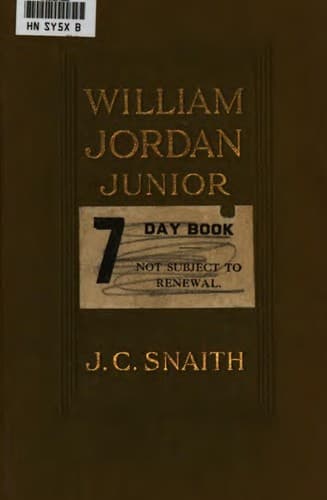
Booksellers and bookselling -- Fiction; Fathers and sons -- Fiction; London (England) -- Fiction; Poets -- Fiction
The boy clasped his frail hands, and strove to conceal the abject fear
in his eyes.
“When, my brave one?”
“To-morrow I will go, my father.”
“So be it then, beloved one.”
In the silence which followed the tense breathing of the frail form
could be heard to surmount the ticking of the clock, the creaking of
the fire, the little voice of the wind, the gurgle of water, and the
great roar of London.
“Are all heroes in bitter fear, my father, when first they go to
school?” asked the boy.
“Indeed, yes.”
“Do they ever tremble like cravens, and do their eyes grow dark?”
“Yes, beloved one.”
“Have not these great ones a strange cowardice, my father?”
“Is not the cowardice of heroes the measure of their courage?”
“Can it be, O my father,” said the boy, with a deepening pallor, “that
these great ones derive their valour from their craven hearts?”
“Truly, beloved, if they learn the secret.”
“The secret, my father?”
“The secret which is only to be learned in the school which is in the
streets of the great city.”
The face of the boy grew like death. “To-morrow then, my father,” he
said in a faint and small voice, “Achilles will adventure forth to this
school which is in the streets of the great city, that he too may learn
this secret. He should have known that one like himself should not only
have great learning, wisdom and constancy, but also a noble valour.”
“True, a thousand times! This is indeed Achilles!”
“I give you good-night, my father. Pray remember me in your vigil.”
The boy threw his arms round the man’s neck, and pressed his cheek
against him. It seemed to burn like a flame.
The boy took a candle from the chimney-piece, lighted it, and in his
great fear of the darkness, was accompanied by his father up the
stairs. When the white-haired man had enveloped the frail form in the
blankets with a woman’s tenderness, he left the light in the chamber
burning at its fullest, and returned to the little room. It was then
near to midnight.
The massive old tome in which he had been reading was open still upon
the table. He knelt before it, pressing his eyes upon the yellow
parchments. On the clock in the little room the hands made their tardy
circuit: midnight passed; one o’clock; two o’clock; three o’clock.
Throughout these hours the man remained thus, not heeding that all
about him was darkness; for the lamp and the fire had burned themselves
out long ago.
Near to the hour of four a ghostly figure, pale but luminous, crept
into the silence of the room. It was the boy, clad in a white gown and
bearing a lighted candle. He touched the kneeling figure softly.
“My father,” he breathed; “how you tremble, my father, and how cold you
are!”
The man rose to his feet with a slight shiver.
“The fire is low,” he said. “Are we not ever cold when the fire is low?”
“The fire is out, my father,” said the boy.
“Is the fire ever out, beloved,” said his father, “while one ember is
still faintly burning? May we not draw it into flame perhaps?”
Public-domain text, read in full here on John Shaqi.
Reviews
Reviews
No reviews yet
Be the first to share your thoughts on this work.
Join the Discussion
Join the discussion
Sign in to leave a comment or review.
Sign InorCreate an account