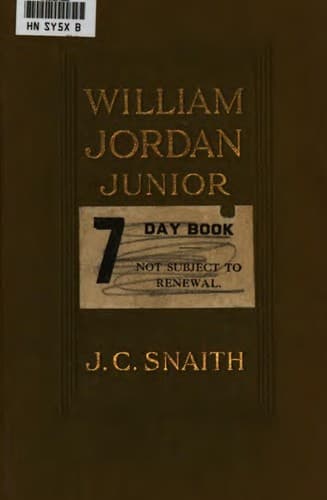
Booksellers and bookselling -- Fiction; Fathers and sons -- Fiction; London (England) -- Fiction; Poets -- Fiction
“You must give me a minute to think, if you please,” he quavered in a
low voice, which in the ears of the boy had the effect of music. “Now
that I am old, my memory, of which I have always been vain, is the
first to desert me. If you are one of my scholars I shall recall you,
for it is my boast that each of my scholars has graven a line in the
tablets of my mind.”
Of a sudden the aged school-master gave a cry of joy.
“Why--why!” he exclaimed, “it must be William Jordan.”
He held out both his hands to the boy’s father with an eagerness that
was like a child’s, and the boy saw that his eyes, which a moment since
were destitute of meaning, had now the pregnant beauty of an ancient
masterpiece.
“O that the hour should be at hand,” said the old man, “when I should
cease to recall William Jordan!”
The old man seemed to avert his face from that of the boy’s father in a
kind of dismay; and his voice pierced the boy with an emotion that he
had never felt before.
“It is thirty years since you saw me last,” said the boy’s father.
“In the flesh as an eager-faced young man,” said the school-master.
“But every night as I sit by the fire, I summon William Jordan to
lead the pageant of my experience. When my spirit is like clay you
stand before it, the first among the valiant, so subtle yet so brave.
When this generation, which is so restless, so brilliant, so full of
vitality, seems to tell me that I am but a survival of a phase which
now is nought, I say to it, ‘So be it, my children, but where is the
William Jordan among you? I would have you show me his peer before I
yield.’”
The boy, whose nature was like the strings of some miraculous
instrument which are not only susceptible to the slightest human touch,
but are also responsive to the delicate waves in the air, knew that
some strange emotion was overwhelming his father, although none could
have perceived it but himself.
“My dear old master,” said the boy’s father, with an indescribable
melancholy, “it is the old voice--the old voice that we loved to hear.
And it is the old courage--the old incomparable suit of mail.”
“A school-master’s courage should increase as he grows old, I think,”
said the old man, whose voice was like a harp. “It is true his age is
menaced by all the noble energies he has failed to mould; by all the
expenditure of spirit, by all the devout patience he has lavished upon
them, which have come to no harvest; but is it not by giving our all
without hope of a requital that in the end teaches us to accept our
destiny?”
The boy’s father stood like a statue before his old preceptor.
“Master, your voice overcomes me,” he said. “But it is just, it is
perfectly just that I should live to hear it sound reproachful in my
ears.”
Public-domain text, read in full here on John Shaqi.
Reviews
Reviews
No reviews yet
Be the first to share your thoughts on this work.
Join the Discussion
Join the discussion
Sign in to leave a comment or review.
Sign InorCreate an account