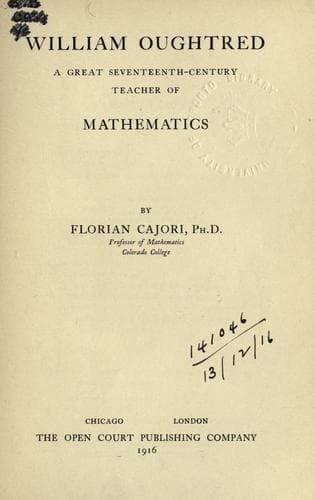
William Oughtred: A Great Seventeenth-Century Teacher of Mathematics — John Shaqi
William Oughtred: A Great Seventeenth-Century Teacher of MathematicsCajori, Florian
History
William Oughtred: A Great Seventeenth-Century Teacher of Mathematics
Cajori, Florian
Mathematicians -- Biography; Mathematics -- Study and teaching -- History -- 17th century; Oughtred, William, 1575-1660
Rigorous Thinking and the Use of Instruments 87
Newton’s Comments on Oughtred 94
Index 97
INTRODUCTION
In the year 1660 the Royal Society was founded by royal favor in London,
although in reality its inception took place in 1645 when the
Philosophical Society (or, as Boyle called it, the “Invisible College”)
came into being, which held meetings at Gresham College in London and
later in Oxford. It was during the second half of the seventeenth century
that Sir Isaac Newton, surrounded by a group of great men—Wallis, Hooke,
Barrow, Halley, Cotes—carried on his epoch-making researches in
mathematics, astronomy, and physics. But it is not this half-century of
science in England, nor any of its great men, that especially engage our
attention in this monograph. It is rather the half-century preceding, an
epoch of preparation, when in the early times of the House of Stuart the
sciences began to flourish in England. Says Dr. A. E. Shipley: “Whatever
were the political and moral deficiencies of the Stuart kings, no one of
them lacked intelligence in things artistic and scientific.” It was at
this time that mathematics, and particularly algebra, began to be
cultivated with greater zeal, when elementary algebra with its symbolism
as we know it now began to take its shape.
Biographers of Sir Isaac Newton make particular mention of five
mathematical books which he read while a young student at Cambridge,
namely, Euclid’s Elements, Descartes’s Géométrie, Vieta’s Works, Van
Schooten’s Miscellanies, and Oughtred’s Clavis mathematicae. The last of
these books has been receiving increasing attention from the historians
of algebra in recent years. We have prepared this sketch because we felt
that there were points of interest in the life and activity of Oughtred
which have not received adequate treatment. Historians have discussed his
share in the development of symbolic algebra, but some have fallen into
errors, due to inability to examine the original editions of Oughtred’s
Clavis mathematicae, which are quite rare and inaccessible to most
readers. Moreover, historians have failed utterly to recognize his
inventions of mathematical instruments, particularly the slide rule; they
have completely overlooked his educational views and his ideas on
mathematical teaching. The modern reader may pause with profit to
consider briefly the career of this interesting man.
Public-domain text, read in full here on John Shaqi.
Reviews
Reviews
No reviews yet
Be the first to share your thoughts on this work.
Join the Discussion
Join the discussion
Sign in to leave a comment or review.
Sign InorCreate an account