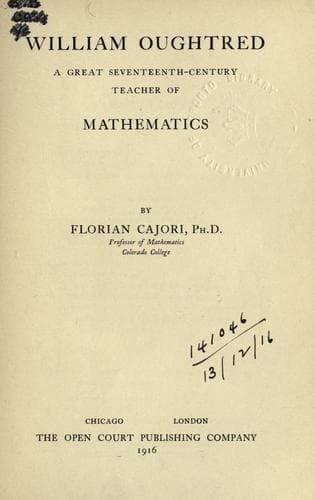
William Oughtred: A Great Seventeenth-Century Teacher of MathematicsCajori, Florian
History
William Oughtred: A Great Seventeenth-Century Teacher of Mathematics
Cajori, Florian
Mathematicians -- Biography; Mathematics -- Study and teaching -- History -- 17th century; Oughtred, William, 1575-1660
Since the extraction of a cube root is merely the solution of a pure
cubic equation, x³=n, the process given above may be utilized in finding
cube roots. This is precisely what Oughtred does in chap. xiv of his
Clavis. If the foregoing computation is modified by putting C_q=0, the
process will yield the approximate cube root of 247651713.
Oughtred solves 16 examples by the process of approximation here
explained. Of these, 9 are cubics, 5 are quartics, and 2 are quintics. In
all cases he finds only one or two real roots. Of the roots sought, five
are irrational, the remaining are rational and are computed to their
exact values. Three of the computed roots have 2 figures each, 9 roots
have 3 figures each, 4 roots have 4 figures each. While no attempt is
made to secure all the roots—methods of computing complex roots were
invented much later—he computes roots of equations which involve large
coefficients and some of them are of a degree as high as the fifth. In
view of the fact that many editions of the Clavis were issued, one
impression as late as 1702, it contributed probably more than any other
book to the popularization of Vieta’s method in England.
Before Oughtred, Thomas Harriot and William Milbourn are the only
Englishmen known to have solved numerical equations of higher degrees.
Milbourn published nothing. Harriot slightly modified Vieta’s process by
simplifying somewhat the formation of the trial divisor. This method of
approximation was the best in existence in Europe until the publication
by Wallis in 1685 of Newton’s method of approximation.
It should be stated that, before the time of Newton, the best method of
approximation to the roots of numerical equations existed, not in Europe,
but in China. As early as the thirteenth century the Chinese possessed a
method which is almost identical with what is known today as “Horner’s
method.”
LOGARITHMS
Oughtred’s treatment of logarithms is quite in accordance with the more
recent practice.[49] He explains the finding of the “index” (our
“characteristic”); he states that “the sum of two Logarithms is the
Logarithm of the Product of their Valors; and their difference is the
Logarithm of the Quotient,” that “the Logarithm of the side [436] drawn
upon the Index number [2] of dimensions of any Potestas is the logarithm
of the same Potestas” [436²], that “the logarithm of any Potestas [436²]
divided by the number of its dimensions [2] affordeth the Logarithm of
its Root [436].” These statements of Oughtred occur for the first time in
the Key of the Mathematicks of 1647; the Clavis of 1631 contains no
treatment of logarithms.
If the characteristic of a logarithm is negative, Oughtred indicates this
fact by placing the - above the characteristic. He separates the
characteristic and mantissa by a comma, but still uses the sign |_ to
indicate decimal fractions. He uses the contraction “log.”
INVENTION OF THE SLIDE RULE; CONTROVERSY ON PRIORITY OF INVENTION
Public-domain text, read in full here on John Shaqi.
Reviews
Reviews
No reviews yet
Be the first to share your thoughts on this work.
Join the Discussion
Join the discussion
Sign in to leave a comment or review.
Sign InorCreate an account