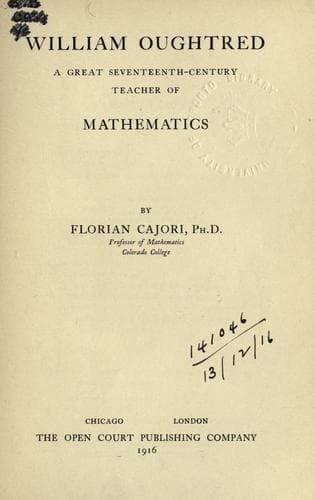
William Oughtred: A Great Seventeenth-Century Teacher of Mathematics — John Shaqi
William Oughtred: A Great Seventeenth-Century Teacher of MathematicsCajori, Florian
History
William Oughtred: A Great Seventeenth-Century Teacher of Mathematics
Cajori, Florian
Mathematicians -- Biography; Mathematics -- Study and teaching -- History -- 17th century; Oughtred, William, 1575-1660
as Torporley, William Lower, and Protheroe in Wales, but this group is
small as compared with Oughtred’s.
OUGHTRED’S PUPILS
There was a large number of distinguished men who, in their youth, either
visited Oughtred’s home and studied under his roof or else read his
Clavis and sought his assistance by correspondence. We permit Aubrey to
enumerate some of these pupils in his own gossipy style:
Seth Ward, M.A., a fellow of Sydney Colledge in Cambridge (now bishop
of Sarum), came to him, and lived with him halfe a yeare (and he would
not take a farthing for his diet), and learned all his mathematiques of
him. Sir Jonas More was with him a good while, and learn’t; he was but
an ordinary logist before. Sir Charles Scarborough was his scholar; so
Dr. John Wallis was his scholar; so was Christopher Wren his scholar,
so was Mr. . . . . Smethwyck, Regiae Societatis Socius. One Mr. Austin
(a most ingeniose man) was his scholar, and studyed so much that he
became mad, fell a laughing, and so dyed, to the great griefe of the
old gentleman. Mr. . . . . Stokes, another scholar, fell mad, and
dream’t that the good old gentleman came to him, and gave him good
advice, and so he recovered, and is still well. Mr. Thomas Henshawe,
Regiae Societatis Socius, was his scholar (then a young gentleman). But
he did not so much like any as those that tugged and tooke paines to
worke out questions. He taught all free.
He could not endure to see a scholar write an ill hand; he taught them
all presently to mend their hands.[56]
Had Oughtred been the means of guiding the mathematical studies of only
John Wallis and Christopher Wren—one the greatest English mathematician
between Napier and Newton, the other one of the greatest architects of
England—he would have earned profound gratitude. But the foregoing list
embraces nine men, most of them distinguished in their day. And yet
Aubrey’s list is very incomplete. It is easy to more than double it by
adding the names of William Forster, who translated from Latin into
English Oughtred’s Circles of Proportion; Arthur Haughton, who brought
out the 1660 Oxford edition of the Circles of Proportion; Robert Wood, an
educator and politician, who assisted Oughtred in the translation of the
Clavis from Latin into English for the edition of 1647; W. Gascoigne, a
man of promise, who fell in 1644 at Marston Moor; John Twysden, who was
active as a publisher; William Sudell, N. Ewart, Richard Shuttleworth,
William Robinson, and William Howard, the son of the Earl of Arundel, for
whose instruction Oughtred originally prepared the manuscript treatise
that was published in 1631 as the Clavis mathematicae.
Public-domain text, read in full here on John Shaqi.
Reviews
Reviews
No reviews yet
Be the first to share your thoughts on this work.
Join the Discussion
Join the discussion
Sign in to leave a comment or review.
Sign InorCreate an account