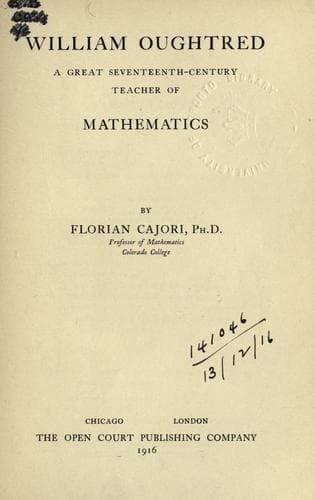
William Oughtred: A Great Seventeenth-Century Teacher of MathematicsCajori, Florian
History
William Oughtred: A Great Seventeenth-Century Teacher of Mathematics
Cajori, Florian
Mathematicians -- Biography; Mathematics -- Study and teaching -- History -- 17th century; Oughtred, William, 1575-1660
The symbol for the arithmetical difference between two numbers, ~, is
usually attributed to John Wallis, but it occurs in Oughtred’s Clavis
mathematicae of 1652, in the tract on Elementi decimi Euclidis
declaratio, at an earlier date than in any of Wallis’ books. As Wallis
assisted in putting this edition through the press it is possible, though
not probable, that the symbol was inserted by him. Were the symbol
Wallis’, Oughtred would doubtless have referred to its origin in the
preface. During the eighteenth century the symbol found its way into
foreign texts even in far-off Italy.[122] It is one of three symbols
presumably invented by Oughtred and which are still used at the present
time. The others are × and ::.
The curious and ill-chosen symbols, |̲̅ ̅ for “greater than,” and ̲ ̲̅|
for “less than,” were certain to succumb in their struggle for existence
against Harriot’s admirably chosen > and <. Yet such was the reputation
of Oughtred that his symbols were used in England quite extensively
during the seventeenth and the beginning of the eighteenth century.
Considerable confusion has existed among algebraists and also among
historians as to what Oughtred’s symbols really were. Particularly is
this true of the sign for “less than” which is frequently written ̅ ̲̅|.
Oughtred’s symbols, or these symbols turned about in some way, have been
used by Seth Ward,[123] John Wallis,[124] Isaac Barrow,[125] John
Kersey,[126] E. Wells,[127] John Hawkins,[128] Tho. Baker,[129] Richard
Sault,[130] Richard Rawlinson,[131] Franciscus Dulaurens,[132] James
Milnes,[133] George Cheyne,[134] John Craig,[135] Jo. Wilson,[136] and J.
Collins.[137]
General acceptance has been accorded to Oughtred’s symbol ×. The first
printed appearance of this symbol for multiplication in 1618 in the form
of the letter x hardly explains its real origin. The author of the
“Appendix” (be he Oughtred or someone else) may not have used the letter
x at all, but may have written the cross ×, called the St. Andrew’s
cross, while the printer, in the absence of any type accurately
representing that cross, may have substituted the letter x in its place.
The hypothesis that the symbol × of multiplication owes its origin to the
old habit of using directed bars to indicate that two numbers are to be
combined, as for instance in the multiplication of 23 and 34, thus,
2 3
|\ /|
| x |
|/ \|
3 4
-------
7 8 2
has been advanced by two writers, C. Le Paige[138] and Gravelaar.[139]
Bosmans is more inclined to the belief that Oughtred adopted the symbol
somewhat arbitrarily, much as he did the numerous symbols in his Elementi
decimi Euclidis declaratio.[140]
Le Paige’s and Gravelaar’s theory finds some support in the fact that the
cross ×, without the two additional vertical lines shown above, occurs in
a commentary published by Oswald Schreshensuchs[141] in 1551, where the
sign is written between two factors placed one above the other.
Public-domain text, read in full here on John Shaqi.
Reviews
Reviews
No reviews yet
Be the first to share your thoughts on this work.
Elsewhere in the archive
Join the Discussion
Join the discussion
Sign in to leave a comment or review.
Sign InorCreate an account