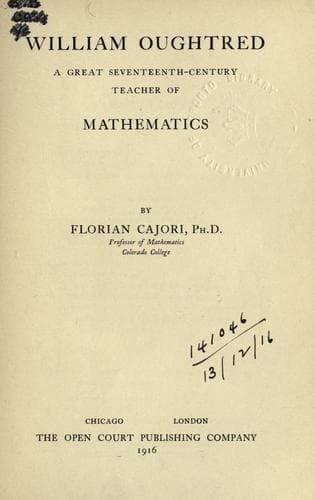
William Oughtred: A Great Seventeenth-Century Teacher of MathematicsCajori, Florian
History
William Oughtred: A Great Seventeenth-Century Teacher of Mathematics
Cajori, Florian
Mathematicians -- Biography; Mathematics -- Study and teaching -- History -- 17th century; Oughtred, William, 1575-1660
Wherefore, that I might more clearly behold the things themselves, I
uncasing the Propositions and Demonstrations out of their covert of
words, designed them in notes and species appearing to the very eye.
After that by comparing the divers affections of Theorems, inequality,
proportion, affinity, and dependence, I tryed to educe new out of them.
It was this motive which led him to introduce the many abbreviations in
algebra and trigonometry to which reference has been made in previous
pages. The pedagogical experience of recent centuries has indorsed
Oughtred’s view, provided of course that the pupil is carefully taught
the exact meaning of the symbols. There have been and there still are
those who oppose the intensive use of symbolism. In our day the new
symbolism for all mathematics, suggested by the school of Peano in Italy,
can hardly be said to be received with enthusiasm. In Oughtred’s day
symbolism was not yet the fashion. To be convinced of this fact one need
only open a book of Edmund Gunter, with whom Oughtred came in contact in
his youth, or consult the Principia of Sir Isaac Newton, who flourished
after Oughtred. The mathematical works of Gunter and Newton, particularly
the former, are surprisingly destitute of mathematical symbols. The
philosopher Hobbes, in a controversy with John Wallis, criticized the
latter for that “Scab of Symbols,” whereupon Wallis replied:
I wonder how you durst touch M. Oughtred for fear of catching the Scab.
For, doubtlesse, his book is as much covered over with the Scab of
Symbols, as any of mine. . . . . As for my Treatise of Conick Sections,
you say, it is covered over with the Scab of Symbols, that you had not
the patience to examine whether it is well or ill demonstrated.[142]
Oughtred maintained his view of the importance of symbols on many
different occasions. Thus, in his Circles of Proportion, 1632, p. 20:
This manner of setting downe Theoremes, whether they be Proportions, or
Equations, by Symboles or notes of words, is most excellent,
artificiall, and doctrinall. Wherefore I earnestly exhort every one,
that desireth though but to looke into these noble Sciences
Mathematicall, to accustome themselves unto it: and indeede it is
easie, being most agreeable to reason, yea even to sence. And out of
this working may many singular consectaries be drawne: which without
this would, it may be, for ever lye hid.
RIGOROUS THINKING AND THE USE OF INSTRUMENTS
The author’s elevated concept of mathematical study as conducive to
rigorous thinking shines through the following extract from his preface
to the 1647 Clavis:
Public-domain text, read in full here on John Shaqi.
Reviews
Reviews
No reviews yet
Be the first to share your thoughts on this work.
Elsewhere in the archive
Join the Discussion
Join the discussion
Sign in to leave a comment or review.
Sign InorCreate an account