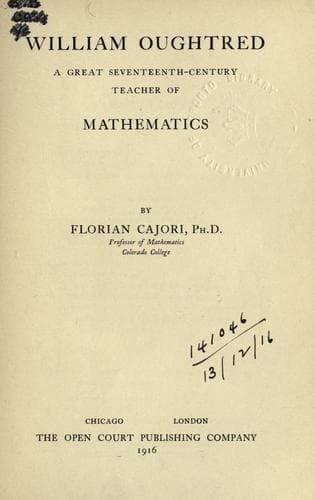
William Oughtred: A Great Seventeenth-Century Teacher of MathematicsCajori, Florian
History
William Oughtred: A Great Seventeenth-Century Teacher of Mathematics
Cajori, Florian
Mathematicians -- Biography; Mathematics -- Study and teaching -- History -- 17th century; Oughtred, William, 1575-1660
Who was right, Oughtred or Delamain? It may be claimed that there is a
middle ground which more nearly represents the ideal procedure in
teaching. Shall the slide rule be placed in the student’s hands at the
time when he is engaged in the mastery of principles? Shall there be an
alternate study of the theory of logarithms and of the slide rule—on the
idea of one hand washing the other—until a mastery of both the theory and
the use of the instrument has been attained? Does this method not produce
the best and most lasting results? Is not this Delamain’s actual
contention? We leave it to the reader to settle these matters from his
own observation, knowledge, and experience.
NEWTON’S COMMENTS ON OUGHTRED
Oughtred is an author who has been found to be of increasing interest to
modern historians of mathematics. But no modern writer has, to our
knowledge, pointed out his importance in the history of the teaching of
mathematics. Yet his importance as a teacher did receive recognition in
the seventeenth century by no less distinguished a scientist than Sir
Isaac Newton. On May 25, 1694, Sir Isaac Newton wrote a long letter in
reply to a request for his recommendation on a proposed new course of
study in mathematics at Christ’s Hospital. Toward the close of his
letter, Newton says:
And now I have told you my opinion in these things, I will give you Mr.
Oughtred’s, a Man whose judgment (if any man’s) may be safely relyed
upon. For he in his book of the circles of proposition, in the end of
what he writes about Navigation (page 184) has this exhortation to
Seamen. “And if,” saith he, “the Masters of Ships and Pilots will take
the pains in the Journals of their Voyages diligently and faithfully to
set down in severall columns, not onely the Rumb they goe on and the
measure of the Ships way in degrees, and the observation of Latitude
and variation of their compass; but alsoe their conjectures and reason
of their correction they make of the aberrations they shall find, and
the qualities and condition of their ship, and the diversities and
seasons of the winds, and the secret motions or agitations of the Seas,
when they begin, and how long they continue, how farr they extend and
with what inequality; and what else they shall observe at Sea worthy
consideration, and will be pleased freely to communicate the same with
Artists, such as are indeed skilfull in the Mathematicks and lovers and
enquirers of the truth: I doubt not but that there shall be in
convenient time, brought to light many necessary precepts which may
tend to y^e perfecting of Navigation, and the help and safety of such
whose Vocations doe inforce them to commit their lives and estates in
the vast Ocean to the providence of God.” Thus farr that very good and
judicious man Mr. Oughtred. I will add, that if instead of sending the
Observations of Seamen to able Mathematicians at Land, the Land would
Public-domain text, read in full here on John Shaqi.
Reviews
Reviews
No reviews yet
Be the first to share your thoughts on this work.
Elsewhere in the archive
Join the Discussion
Join the discussion
Sign in to leave a comment or review.
Sign InorCreate an account