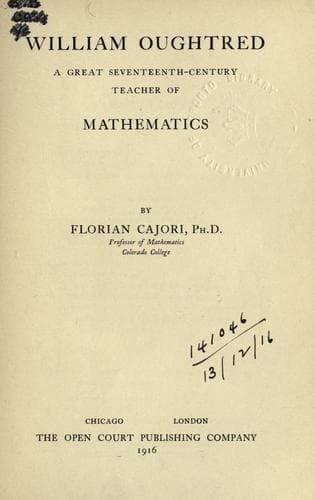
William Oughtred: A Great Seventeenth-Century Teacher of MathematicsCajori, Florian
History
William Oughtred: A Great Seventeenth-Century Teacher of Mathematics
Cajori, Florian
Mathematicians -- Biography; Mathematics -- Study and teaching -- History -- 17th century; Oughtred, William, 1575-1660
It is somewhat of a paradox that Oughtred, who in his student days and
during his active years felt himself impelled to invent sun-dials,
planispheres, and various types of slide rules—instruments which
represent the most original contributions which he handed down to
posterity—should discourage the use of such instruments in teaching
mathematics to beginners. That without the aid of instruments he himself
should have succeeded so well in attracting and inspiring young men
constitutes the strongest evidence of his transcendent teaching ability.
It may be argued that his pedagogic dogma, otherwise so excellent, here
goes contrary to the course he himself followed instinctively in his
self-education along mathematical lines. We read that Sir Isaac Newton,
as a child, constructed sun-dials, windmills, kites, paper lanterns, and
a wooden clock. Should these activities have been suppressed? Ordinary
children are simply Isaac Newtons on a smaller intellectual scale. Should
their activities along these lines be encouraged or checked?
On the other hand, it may be argued that the paradox alluded to above
admits of explanation, like all paradoxes, and that there is no
inconsistency between Oughtred’s pedagogic views and his own course of
development. If he invented sun-dials, he must have had a comprehension
of the cosmic motions involved; if he solved spherical triangles
graphically by the aid of the planisphere, he must have understood the
geometry of the sphere, so far as it relates to such triangles; if he
invented slide rules, he had beforehand a thorough grasp of logarithms.
The question at issue does not involve so much the invention of
instruments, as the use by the pupil of instruments already constructed,
before he fully understands the theory which is involved. Nor does Sir
Isaac Newton’s activity as a child establish Delamain’s contention. Of
course, a child should not be discouraged from manual activity along the
line of producing interesting toys in imitation of structures and
machines that he sees, but to introduce him to the realm of abstract
thought by the aid of instruments is a different proposition, fraught
with danger. A boy may learn to use a slide rule mechanically and,
because of his ability to obtain practical results, feel justified in
foregoing the mastery of underlying theory; or he may consider the
ability of manipulating a surveying instrument quite sufficient, even
though he be ignorant of geometry and trigonometry; or he may learn how
to operate a dynamo and an electric switchboard and be altogether
satisfied, though having no grasp of electrical science. Thus instruments
draw a youth aside from the path leading to real intellectual attainments
and real efficiency; they allure him into lanes which are often blind
alleys. Such were the views of Oughtred.
Public-domain text, read in full here on John Shaqi.
Reviews
Reviews
No reviews yet
Be the first to share your thoughts on this work.
Elsewhere in the archive
Join the Discussion
Join the discussion
Sign in to leave a comment or review.
Sign InorCreate an account