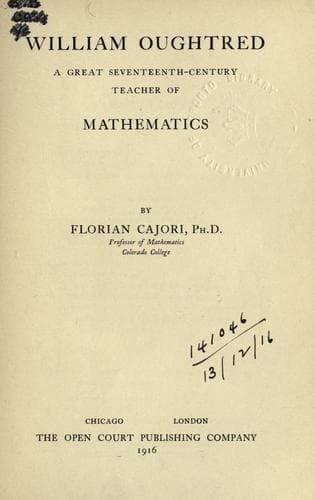
William Oughtred: A Great Seventeenth-Century Teacher of MathematicsCajori, Florian
History
William Oughtred: A Great Seventeenth-Century Teacher of Mathematics
Cajori, Florian
Mathematicians -- Biography; Mathematics -- Study and teaching -- History -- 17th century; Oughtred, William, 1575-1660
[111]Application de la géométrie ordinaire et des calculs différentiel et
intégral, by M. Robillard, Paris, 1753.
[112]Traité de géométrie théorique et pratique, new ed., Paris, 1764, p.
15.
[113]Recherches sur les courbes à double courbure, Paris, 1731, p. 13.
[114]Analyse des infiniment petits, by the Marquis de L’Hospital. New ed.
by M. Le Fèvre, Paris, 1781, p. 41. In this volume passages in fine
print, probably supplied by the editor, contain the notation a:b::c:d;
the parts in large type give Oughtred’s original notation.
[115]The tendency during the eighteenth century is shown in part by the
following data: Jacobi Bernoulli Opera, Tomus primus, Geneva, 1744,
gives B.A::D.C on p. 368, the paper having been first published in
1688; on p. 419 is given GE:AG=LA:ML, the paper having been first
published in 1689. Bernhardi Nieuwentiit, Considerationes circa
analyseos ad quantitates infinitè parvas applicatae principia,
Amsterdam, 1694, p. 20, and Analysis infinitorum, Amsterdam, 1695, on
p. 276, have x:c::s:r. Paul Halcken’s Deliciae mathematicae, Hamburg,
1719, gives a:b::c:d. Johannis Baptistae Caraccioli, Geometria
algebraica universa, Rome, 1759, p. 79, has a.b::c.d. Delle corde
ouverto fibre elastiche schediasmi fisico-matematici del conte
Giordano Riccati, Bologna, 1767, p. 65, gives P:b::r:ds. “Produzioni
mathematiche” del Conte Giulio Carlo de Fagnano, Vol. I, Pesario,
1750, p. 193, has a.b::c.d. L. Mascheroni, Géométrie du compas,
translated by A. M. Carette, Paris, 1798, p. 188, gives
√(3):2::√(2):Lp. Danielis Melandri and Paulli Frisi, De theoria lunae
commentarii, Parma, 1769, p. 13, has a:b::c:d. Vicentio Riccato and
Hieronymo Saladino, Institutiones analyticae, Vol. I, Bologna, 1765,
p. 47, gives x:a::m:n+m. R. G. Boscovich, Opera pertinentia ad opticam
et astronomiam, Bassani, 1785, p. 409, uses a:b::c:d. Jacob Bernoulli,
Ars Conjectandi, Basel, 1713, has n-r.n-1::c.d. Pavlini Chelvicii,
Institutiones analyticae, editio post tertiam Romanam prima in
Germania, Vienna, 1761, p. 2, a.b::c.d. Christiani Wolfii, Elementa
matheseos universae, Vol. III, Geneva, 1735, p. 63, has AB:AE=1:q.
Johann Bernoulli, Opera omnia, Vol. I, Lausanne and Geneva, 1742, p.
43, has a:b=c:d. D. C. Walmesley, Analyse des mesures des rapports et
des angles, Paris, 1749, uses extensively a.b::c.d, later a:b::c:d. G.
W. Krafft, Institutiones geometriae sublimoris, Tübingen, 1753, p.
194, has a:b=c:d. J. H. Lambert, Photometria, 1760, p. 104, has C:π
=BC²:MH². Meccanica sublime del Dott. Domenico Bartaloni, Naples,
1765, has a:b::c:d. Occasionally ratio is not designated by a.b, nor
by a:b, but by a, b, as for instance in A. de Moivre’s Doctrine of
Chance, London, 1756, p. 34, where he writes a, b::1, q. A further
variation in the designation of ratio is found in James Atkinson’s
Epitome of the Art of Navigation, London, 1718, p.
Public-domain text, read in full here on John Shaqi.
Reviews
Reviews
No reviews yet
Be the first to share your thoughts on this work.
Elsewhere in the archive
Join the Discussion
Join the discussion
Sign in to leave a comment or review.
Sign InorCreate an account